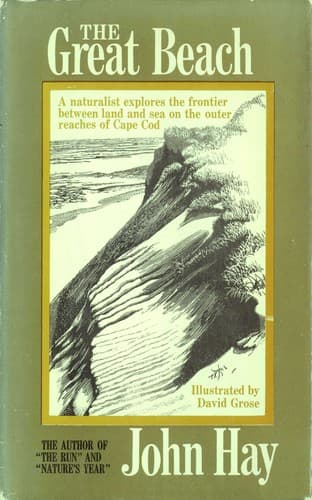
Cape Cod (Mass.) -- Description and travel; Natural history -- Massachusetts -- Cape Cod
During a violent coastal storm, with winds up to seventy and eighty
miles an hour, an exhausted harbor porpoise was cast up on a bay beach
recently, and there it died. I confess I had never seen one out of
water or even close to me before. For all the pictures I had seen, and
all I had read, nothing prepared me for such perfection. Its round
body, four to five feet long, was butt-ended at its head, in which
there were small eyes, and small teeth in the jaws. It had just as much
of the quality of flow as a raindrop, and at the same time was a solid
packing of energy. Its skin graded down from the jet black of its back
and upper sides through streaks of gray like rain along the sea down
to a white belly, and without scales, it had a thick, smooth satiny
polish like ebony or horn, perhaps reminiscent of synthetic rubber or
plastic but of an organic texture which neither of those products could
equal. The porpoise had a single fin on its back and a tail that could
strike vertically for power and thrust. Its body was fairly heavy,
weighing about a hundred pounds, but everything of speed and liquidity
and dashing, leaping strength was reflected there. It lay on the upper
part of the beach, conspicuous among the long piles of storm litter,
the logs, pieces of broken dories, and thick seaweed, spectacular in
its simplicity, a black and white that made me think of breaking waves
in the night sea. I saw it curve over the surfaces of the water with
consummate grace, slide away, and disappear.
“Where did you ever see more of nothing?” I was once asked as I looked
out over endless dry Texas plains billowing like waves. Nothing or
everything. Who knows? Who knows what the emptiness leads to or
contains? The beach lies open. Its sands and rattling stones lead back
through ages of weathering and change and are at the same time part of
the wide give and take of the present.
The tiny spider crab, though isolated on the beach, was also a link
with a teeming offshore existence, which hid in shadowy worlds of kelp
and rockweed, or floated and roamed by with a free energy that was in
complete denial of our tightening fall and winter world. Backed by a
cliff, walking on sands shadowed and cold, faced by the churning waves,
it is hard to believe in a life so rich. There are no rocky shores
revealed at low tide and streaming with weed to prove the temperate
fertility of the sea. The beach is a transition zone between one
environment and another, but except in those areas where the cliffs are
reduced to low sand hills, protecting a marsh or estuary behind them,
the transition is a sharp one, the sands dipping from the inconstant
sky to the constancy of salt water.
Public-domain text, read in full here on John Shaqi.
Reviews
Reviews
No reviews yet
Be the first to share your thoughts on this work.
Join the Discussion
Join the discussion
Sign in to leave a comment or review.
Sign InorCreate an account