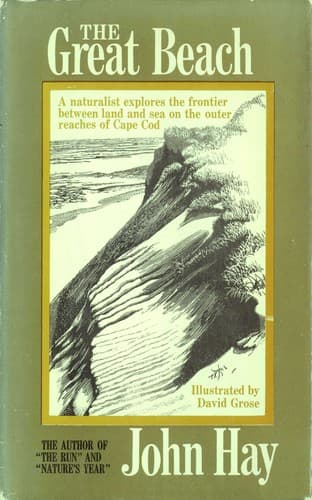
Cape Cod (Mass.) -- Description and travel; Natural history -- Massachusetts -- Cape Cod
The shells of dead diatoms rain down through the water and form thick
deposits on the floor of the sea. The cliffs above the beach are full
of them. Cities have been built on their fossilized shells. In their
number the diatoms balance the magnitude of the sea. In size they are
basic to the existence of the minuscule animals of the zooplankton that
feed upon them, and are eaten by larger animals in turn. A diatom’s
delicacy and sparkling beauty as it reflects the light could indicate
that universal productivity must start with a jewel, and perhaps end
with it too.
That which is minute, like the diatoms, or cells, which are the basic
structure of life, is a clue to the significance of things, leading
from the simple to the complex and multifarious, but finally rounding
us back to where we started. A man himself is the unique single cell
with its own nature. Each life has its irreducible quality. I have been
told that if you look at a diatom through an electronic microscope,
from one increased magnification to another, you can see all its
protuberances and layers disappear, and finally a sparkling crystalline
form is revealed, like a cosmic surprise.
I suppose it is part of my fate as a large and clumsy animal of the
mammalian order, crashing through the underbrush, knocking down trees,
and displacing earth’s other inhabitants, to miss a great deal, at
least with my unassisted eyes. To learn about some new form of life
which I may have been passing by for years is often something of a
redemption. I can then say that we have not yet been so run down by our
own traffic that we have lost the capacity to see.
Not long ago a colony of bryozoans was pointed out to me, at least the
gelatinous crusts of the compartments in which they lived, like little
tufts and fringes attached to the fronds of seaweed cast up on the
beach. They are tiny colonial animals that make cups and compartments
joined together in branching stems, from which they send out little
crowns of delicate, filamentous tentacles waving in the water. There
are three thousand marine species of them, growing in different forms,
and having different surfaces for their attachment. I had thought
previously that the little pale-colored, branched tufts were a part of
the seaweed. Now another small marvel had appeared on my horizon.
Public-domain text, read in full here on John Shaqi.
Reviews
Reviews
No reviews yet
Be the first to share your thoughts on this work.
Join the Discussion
Join the discussion
Sign in to leave a comment or review.
Sign InorCreate an account