Avon was bright, alert, unusually active, and exceedingly fond of horses
from the time he was able to walk. His uncle had served through the
Civil War in the Confederate army, returning to Texas at the close of
hostilities, thoroughly "reconstructed," and only anxious to recover his
fortunes, which had been scattered to the four winds of heaven during
the long, bitter struggle.
The captain had no children of his own, and it was natural, therefore,
that he and his wife should feel the strongest attachment for the boy
who was placed in their care, and who, should his life be spared, would
inherit whatever his new parents might be able to leave behind them when
called to depart.
Avon had reached the age named, when to his delight he was told that he
was to accompany the large herd of cattle which was to be driven
northward, through upper Texas, the Indian Nation, and Kansas over the
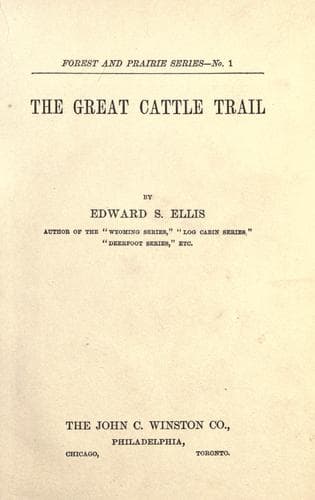
Great Cattle Trail, along which hundreds of thousands of hoofs have
tramped during the years preceding and following the War for the Union.
Young as was our hero, he had served his apprenticeship at the cattle
business, and was an expert at the round-up, in branding, in cutting
out, in herding, and all the arduous requirements of a cowboy's life. It
was understood, therefore, that he was to be rated as a full hand among
the eight men who, under his uncle, were to have charge of two thousand
cattle about to start on the long tramp northward.
"It's the hardest kind of work," said the captain to his nephew, as the
two sat in the low, flat structure where the veteran made his home, with
his wife and one colored servant, "but I haven't any fear that you will
not pull through all right."
"If I am not able to do so _now_, I never shall be," replied Avon, with
a smile, as he sat on the rough, home-made stool, slowly whittling a
piece of wood, while his aunt, looking up from her sewing, remarked in
her quiet way:
"It will be lonesome without Avon."
"But not so bad as when uncle was off to the war," ventured the youth,
gazing affectionately at the lady.
The captain was sitting with his legs crossed, slowly smoking the old
briarwood which he had carried through many a fierce campaign, and
seemingly sunk in deep thought. Like his nephew, he was clad in the
strong serviceable costume of the Texan cowboy, his broad sombrero
resting with a number of blankets on pegs in the wall.
It was evening, with a cold, piercing wind almost like one of the
cutting northers blowing around the homely structure. The herd were
gathered at a point about five miles to the northward, whence the real
start was to be made at an early hour on the morrow. This arrangement
permitted the captain and his young friend to spend their last night at
home.
"No," replied Mrs. Shirril, referring to the last remark of her nephew,
"there never can be any worse days than those, when I did not know
whether your uncle had not been dead for weeks or possibly months."
Public-domain text, read in full here on John Shaqi.
Reviews
Reviews
No reviews yet
Be the first to share your thoughts on this work.
Join the Discussion
Join the discussion
Sign in to leave a comment or review.
Sign InorCreate an account