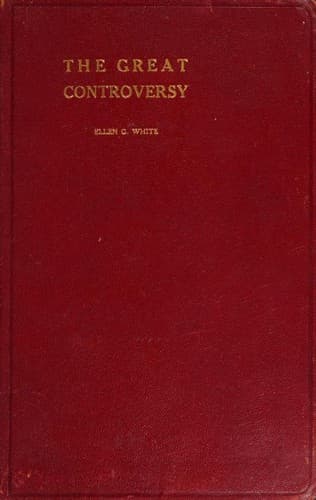
The Great Controversy Between Christ and SatanWhite, Ellen Gould Harmon
ReligionComparative
The Great Controversy Between Christ and Satan
White, Ellen Gould Harmon
Good and evil; Seventh-Day Adventists -- Doctrines; Spiritual direction
“The Scriptures,” said Zwingle, “come from God, not from man, and even
that God who enlightens will give thee to understand that the speech comes
from God. The word of God ... cannot fail; it is bright, it teaches
itself, it discloses itself, it illumines the soul with all salvation and
grace, comforts it in God, humbles it, so that it loses and even forfeits
itself, and embraces God.”(243) The truth of these words Zwingle himself
had proved. Speaking of his experience at this time, he afterward wrote:
“When ... I began to give myself wholly up to the Holy Scriptures,
philosophy and theology (scholastic) would always keep suggesting quarrels
to me. At last I came to this, that I thought, ‘Thou must let all that
lie, and learn the meaning of God purely out of His own simple word.’ Then
I began to ask God for His light, and the Scriptures began to be much
easier to me.”(244)
The doctrine preached by Zwingle was not received from Luther. It was the
doctrine of Christ. “If Luther preaches Christ,” said the Swiss Reformer,
“he does what I am doing. Those whom he has brought to Christ are more
numerous than those whom I have led. But this matters not. I will bear no
other name than that of Christ, whose soldier I am, and who alone is my
chief. Never has one single word been written by me to Luther, nor by
Luther to me. And why?... That it might be shown how much the Spirit of
God is in unison with itself, since both of us, without any collusion,
teach the doctrine of Christ with such uniformity.”(245)
In 1516 Zwingle was invited to become a preacher in the convent at
Einsiedeln. Here he was to have a closer view of the corruptions of Rome,
and was to exert an influence as a Reformer that would be felt far beyond
his native Alps. Among the chief attractions of Einsiedeln was an image of
the Virgin which was said to have the power of working miracles. Above the
gateway of the convent was the inscription, “Here a plenary remission of
sins may be obtained.”(246) Pilgrims at all seasons resorted to the shrine
of the Virgin, but at the great yearly festival of its consecration,
multitudes came from all parts of Switzerland, and even from France and
Germany. Zwingle, greatly afflicted at the sight, seized the opportunity
to proclaim liberty through the gospel to these bond-slaves of
superstition.
Public-domain text, read in full here on John Shaqi.
Reviews
Reviews
No reviews yet
Be the first to share your thoughts on this work.
Elsewhere in the archive
Join the Discussion
Join the discussion
Sign in to leave a comment or review.
Sign InorCreate an account