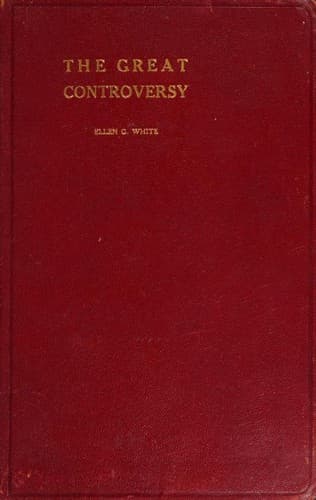
The Great Controversy Between Christ and SatanWhite, Ellen Gould Harmon
ReligionComparative
The Great Controversy Between Christ and Satan
White, Ellen Gould Harmon
Good and evil; Seventh-Day Adventists -- Doctrines; Spiritual direction
“Do not imagine,” he said, “that God is in this temple more than in any
other part of creation. Whatever be the country in which you dwell, God is
around you, and hears you.... Can unprofitable works, long pilgrimages,
offerings, images, the invocation of the Virgin or of the saints, secure
for you the grace of God?... What avails the multitude of words with which
we embody our prayers? What efficacy has a glossy cowl, a smooth-shorn
head, a long and flowing robe, or gold-embroidered slippers?... God looks
at the heart, and our hearts are far from Him.” “Christ,” he said, “who
was once offered upon the cross, is the sacrifice and victim, that had
made satisfaction for the sins of believers to all eternity.”(247)
To many listeners these teachings were unwelcome. It was a bitter
disappointment to them to be told that their toilsome journey had been
made in vain. The pardon freely offered to them through Christ they could
not comprehend. They were satisfied with the old way to heaven which Rome
had marked out for them. They shrank from the perplexity of searching for
anything better. It was easier to trust their salvation to the priests and
the pope than to seek for purity of heart.
But another class received with gladness the tidings of redemption through
Christ. The observances enjoined by Rome had failed to bring peace of
soul, and in faith they accepted the Saviour’s blood as their
propitiation. These returned to their homes to reveal to others the
precious light which they had received. The truth was thus carried from
hamlet to hamlet, from town to town, and the number of pilgrims to the
Virgin’s shrine greatly lessened. There was a falling off in the
offerings, and consequently in the salary of Zwingle, which was drawn from
them. But this caused him only joy as he saw that the power of fanaticism
and superstition was being broken.
The authorities of the church were not blind to the work which Zwingle was
accomplishing; but for the present they forbore to interfere. Hoping yet
to secure him to their cause, they endeavored to win him by flatteries;
and meanwhile the truth was gaining a hold upon the hearts of the people.
Zwingle’s labors at Einsiedeln had prepared him for a wider field, and
this he was soon to enter. After three years here, he was called to the
office of preacher in the cathedral at Zurich. This was then the most
important town of the Swiss confederacy, and the influence exerted here
would be widely felt. The ecclesiastics by whose invitation he came to
Zurich were, however, desirous of preventing any innovations, and they
accordingly proceeded to instruct him as to his duties.
Public-domain text, read in full here on John Shaqi.
Reviews
Reviews
No reviews yet
Be the first to share your thoughts on this work.
Elsewhere in the archive
Join the Discussion
Join the discussion
Sign in to leave a comment or review.
Sign InorCreate an account