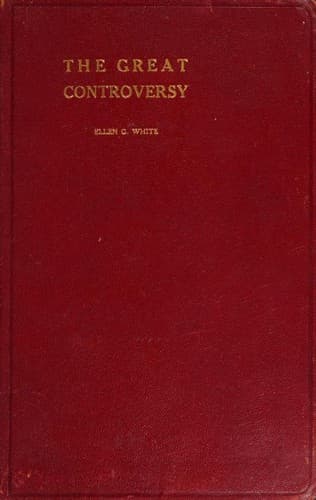
The Great Controversy Between Christ and SatanWhite, Ellen Gould Harmon
ReligionComparative
The Great Controversy Between Christ and Satan
White, Ellen Gould Harmon
Good and evil; Seventh-Day Adventists -- Doctrines; Spiritual direction
“If their doctrine is stricter than this, they are to blame; but you know
in your conscience it is not. And who can be one jot less strict without
corrupting the word of God? Can any steward of the mysteries of God be
found faithful if he change any part of that sacred depositum? No. He can
abate nothing, he can soften nothing; he is constrained to declare to all
men, ‘I may not bring down the Scripture to your taste. You must come up
to it, or perish forever.’ This is the real ground of that other popular
cry concerning ‘the uncharitableness of these men.’ Uncharitable, are
they? In what respect? Do they not feed the hungry and clothe the naked?
‘No; that is not the thing: they are not wanting in this: but they are so
uncharitable in judging! they think none can be saved but those of their
own way.’ ”(376)
The spiritual declension which had been manifest in England just before
the time of Wesley, was in great degree the result of Antinomian teaching.
Many affirmed that Christ had abolished the moral law, and that Christians
are therefore under no obligation to observe it; that a believer is freed
from the “bondage of good works.” Others, though admitting the perpetuity
of the law, declared that it was unnecessary for ministers to exhort the
people to obedience of its precepts, since those whom God had elected to
salvation would, “by the irresistible impulse of divine grace, be led to
the practice of piety and virtue,” while those who were doomed to eternal
reprobation “did not have power to obey the divine law.”
Others, also holding that “the elect cannot fall from grace nor forfeit
the divine favor,” arrived at the still more hideous conclusion that “the
wicked actions they commit are not really sinful, nor to be considered as
instances of their violation of the divine law, and that consequently they
have no occasion either to confess their sins or to break them off by
repentance.”(377) Therefore, they declared that even one of the vilest of
sins, “considered universally an enormous violation of the divine law, is
not a sin in the sight of God,” if committed by one of the elect, “because
it is one of the essential and distinctive characteristics of the elect,
that they cannot do anything that is either displeasing to God or
prohibited by the law.”
These monstrous doctrines are essentially the same as the later teaching
of popular educators and theologians,—that there is no unchangeable divine
law as the standard of right, but that the standard of morality is
indicated by society itself, and has constantly been subject to change.
All these ideas are inspired by the same master-spirit,—by him who, even
among the sinless inhabitants of heaven, began his work of seeking to
break down the righteous restraints of the law of God.
Public-domain text, read in full here on John Shaqi.
Reviews
Reviews
No reviews yet
Be the first to share your thoughts on this work.
Elsewhere in the archive
Join the Discussion
Join the discussion
Sign in to leave a comment or review.
Sign InorCreate an account