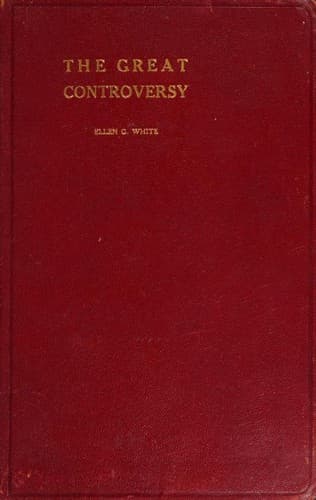
The Great Controversy Between Christ and SatanWhite, Ellen Gould Harmon
ReligionComparative
The Great Controversy Between Christ and Satan
White, Ellen Gould Harmon
Good and evil; Seventh-Day Adventists -- Doctrines; Spiritual direction
The doctrine of the divine decrees, unalterably fixing the character of
men, had led many to a virtual rejection of the law of God. Wesley
steadfastly opposed the errors of the Antinomian teachers, and showed that
this doctrine which led to Antinomianism was contrary to the Scriptures.
“The grace of God that bringeth salvation hath appeared to _all men_.”
“This is good and acceptable in the sight of God our Saviour; who will
have _all men_ to be saved; and to come unto the knowledge of the truth.
For there is one God, and one mediator between God and men, the man Christ
Jesus; who gave Himself a ransom for _all_.”(378) The Spirit of God is
freely bestowed, to enable every man to lay hold upon the means of
salvation. Thus Christ, “the true Light,” “lighteth every man that cometh
into the world.”(379) Men fail of salvation through their own wilful
refusal of the gift of life.
In answer to the claim that at the death of Christ the precepts of the
decalogue had been abolished with the ceremonial law, Wesley said: “The
moral law, contained in the ten commandments and enforced by the prophets,
He did not take away. It was not the design of His coming to revoke any
part of this. This is a law which never can be broken, which ‘stands fast
as the faithful witness in heaven.’ ... This was from the beginning of the
world, being ‘written not on tables of stone,’ but on the hearts of all
the children of men, when they came out of the hands of the Creator. And
however the letters once wrote by the finger of God are now in a great
measure defaced by sin, yet can they not wholly be blotted out, while we
have any consciousness of good and evil. Every part of this law must
remain in force upon all mankind, and in all ages; as not depending either
on time or place, or any other circumstances liable to change, but on the
nature of God, and the nature of man, and their unchangeable relation to
each other.
“ ‘I am not come to destroy, but to fulfil.’... Without question, His
meaning in this place is (consistently with all that goes before and
follows after),—I am come to establish it in its fulness, in spite of all
the glosses of men: I am come to place in a full and clear view whatsoever
was dark or obscure therein: I am come to declare the true and full import
of every part of it; to show the length and breadth, the entire extent, of
every commandment contained therein, and the height and depth, the
inconceivable purity and spirituality of it in all its branches.”(380)
Public-domain text, read in full here on John Shaqi.
Reviews
Reviews
No reviews yet
Be the first to share your thoughts on this work.
Elsewhere in the archive
Join the Discussion
Join the discussion
Sign in to leave a comment or review.
Sign InorCreate an account