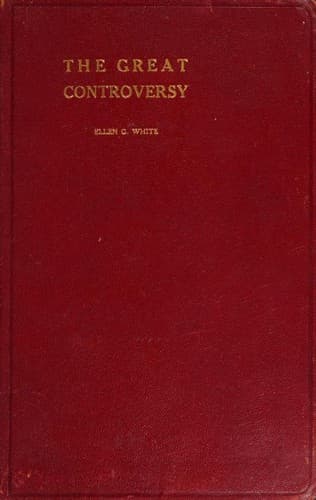
The Great Controversy Between Christ and SatanWhite, Ellen Gould Harmon
ReligionComparative
The Great Controversy Between Christ and Satan
White, Ellen Gould Harmon
Good and evil; Seventh-Day Adventists -- Doctrines; Spiritual direction
Before the entrance of sin, Adam enjoyed open communion with his Maker;
but since man separated himself from God by transgression, the human race
has been cut off from this high privilege. By the plan of redemption,
however, a way has been opened whereby the inhabitants of the earth may
still have connection with heaven. God has communicated with men by His
Spirit, and divine light has been imparted to the world by revelations to
His chosen servants. “Holy men of God spake as they were moved by the Holy
Ghost.” 2 Peter 1:21.
During the first twenty-five hundred years of human history, there was no
written revelation. Those who had been taught of God, communicated their
knowledge to others, and it was handed down from father to son, through
successive generations. The preparation of the written word began in the
time of Moses. Inspired revelations were then embodied in an inspired
book. This work continued during the long period of sixteen hundred
years,—from Moses, the historian of creation and the law, to John, the
recorder of the most sublime truths of the gospel.
The Bible points to God as its author; yet it was written by human hands;
and in the varied style of its different books it presents the
characteristics of the several writers. The truths revealed are all “given
by inspiration of God” (2 Tim. 3:16); yet they are expressed in the words
of men. The Infinite One by His Holy Spirit has shed light into the minds
and hearts of His servants. He has given dreams and visions, symbols and
figures; and those to whom the truth was thus revealed, have themselves
embodied the thought in human language.
The ten commandments were spoken by God Himself, and were written by His
own hand. They are of divine, and not of human composition. But the Bible,
with its God-given truths expressed in the language of men, presents a
union of the divine and the human. Such a union existed in the nature of
Christ, who was the Son of God and the Son of man. Thus it is true of the
Bible, as it was of Christ, that “the Word was made flesh, and dwelt among
us.” John 1:14.
Written in different ages, by men who differed widely in rank and
occupation, and in mental and spiritual endowments, the books of the Bible
present a wide contrast in style, as well as a diversity in the nature of
the subjects unfolded. Different forms of expression are employed by
different writers; often the same truth is more strikingly presented by
one than by another. And as several writers present a subject under varied
aspects and relations, there may appear, to the superficial, careless, or
prejudiced reader, to be discrepancy or contradiction, where the
thoughtful, reverent student, with clearer insight, discerns the
underlying harmony.
Public-domain text, read in full here on John Shaqi.
Reviews
Reviews
No reviews yet
Be the first to share your thoughts on this work.
Join the Discussion
Join the discussion
Sign in to leave a comment or review.
Sign InorCreate an account