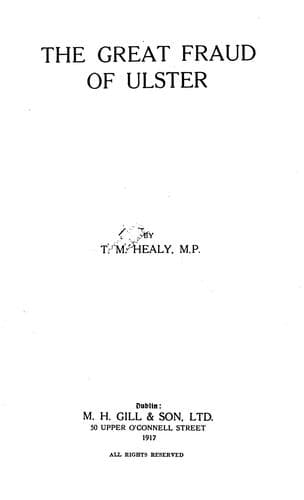
The great fraud of UlsterHealy, T. M. (Timothy Michael)
History
The great fraud of Ulster
Healy, T. M. (Timothy Michael)
Ireland -- History -- 17th century; Ulster (Northern Ireland and Ireland) -- History
The absence of such signal parchments from the archivist’s roster
contrasts oddly with what he put forward to enhance the value of the
grant of 1621—which flowed from Allen’s misconduct at Carrickfergus.
This was the only Patent purporting to give Lough Neagh and the Bann
direct to the “great Deputy.” It was the last in his lifetime. The
affidavit deposed that it reserved to the Crown a rent of £920 a year
(or in present moneys £9,000). So large a rent made for belief in its
genuineness; and the Courts were struck by the figure. Yet, plain on
the face of the enrolment, the true rent was shown to be £30 15s. 6d.
(thirty pounds fifteen shillings and six pence). Amazement is palsied
by such artistry.
A wry presentation was made of facts and Patents which it was
essential to justice to have rightly understood. The high position
of the archivist led to his affidavits being accepted trustingly,
while the fishermen were ill-equipped for a struggle needing years of
research.
CHAPTER XXVIII.
THE FINAL FORGERY.
Apart from the mis-statements of the archivist, the absence of
information which has since become available told heavily for the
disputed Patents.
Although the King’s Letter to Thomas Irelande only authorised a gift
to the value of £100 a year, the Courts were not advised that it
had been drawn upon by a previous grant. Before 1606, if not then
sterile, its fecundity had been much diminished. Yet the Patent of
1606 gave away a million’s worth of property besides the fisheries.
The improbability of James I.’s consenting to this devastation of
Crown estate would naturally attract suspicion as to the genuineness
of the grant, had attention been called to its sweeping nature.
Even if the tapster at the “Half-Moon” had presented the Crown with
£1,678 6s. 8d., the likelihood of royal sanction for a grossly
excessive requital was slight. “New lamps for old” may be given away
in Aladdin-land; but in the England of James I. it was inconceivable
that his Majesty would consent to so reward such a payment. In any
case it was incredible that he would allow his subordinates to part
with a million on a warrant for £100, with leagues of river and
square miles of lake flung in as a “tilla” or “hors d’œuvre.”
The Courts were unaware of the extent of the Patent; and though, in
one sense, the rest of its contents did not touch the question of the
fisheries, its magnitude bore strongly on the question of a genuine
emanation of the Royal will. The same challenge to the realities
arose under the hasty conveyance of the plunder by Hamilton to
Chichester, for which no honest explanation could exist. Again, its
stowage away and muffling up in the bogus Patent to Bassett spoke
shrilly of illegality, but as to all this no warning hint came from
any expert to guide his Majesty’s Judges.
Public-domain text, read in full here on John Shaqi.
Reviews
Reviews
No reviews yet
Be the first to share your thoughts on this work.
Elsewhere in the archive
Join the Discussion
Join the discussion
Sign in to leave a comment or review.
Sign InorCreate an account