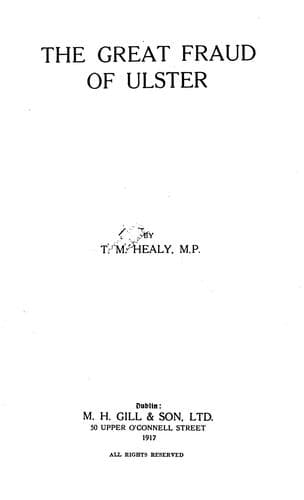
The great fraud of UlsterHealy, T. M. (Timothy Michael)
History
The great fraud of Ulster
Healy, T. M. (Timothy Michael)
Ireland -- History -- 17th century; Ulster (Northern Ireland and Ireland) -- History
At that date no “forfeiture or attainder” from which grants under the
Thomas Irelande “Letter” were to spring had been suffered by anyone
except the monks. It was under Irelande’s Letter they were given
to Hamilton, and, leaving Lough Neagh out of account, a test can
be applied to the bearing of the Commission and Inquisition by the
“finding” as to the Bann. This contained no allegation that the river
belonged to the Crown. In 1605-6 the owners of the Bann were as well
known and as rightfully in possession as the owner of the Throne of
England. If “half Lough Neagh” was found to be the King’s, why did
not the Inquisition declare the Bann to be Crown property, instead
of dealing merely with monastery fishings therein? Yet the whole
non-tidal river was seized as completely as the Lough by Hamilton’s
Patent seven months later.
The reason was that Chichester had made friends with Hamilton,
and arranged to pervert the grant into a conduit-pipe by which
the fisheries were passed to himself. Thereupon his “life-estate”
blossomed gaudily into flower as fee-simple by the magic of a secret
conveyance from “the Scot.” This was done without the payment
of a penny to Hamilton—so cheap was “the price of Admiralty” in
Chichester’s day.
The infected grants of 1603-4, therefore, are the real fount of
title, and furnish the clues which the House of Lords in 1878
declared should be traced. No confiscations had taken place in
Ulster in 1603-4 save those affecting monasteries. The province was
in profound peace under the treaty with O’Neill. Chichester had not
become Deputy, and the absence of royal authority or foreknowledge
as to the gift of fishery in the Patents is plain from the King’s
Letters. These were withheld at the trial as completely as the grants
they were supposed to sanction, for the archivist was “satisfied”
such trumpery was not to be met with in the Record Office—although he
declared himself “thoroughly acquainted” with searches there.
Another omission from the archivist’s list is markworthy. This was
the non-mention of the second master-Patent in the series—that by
Chichester to his nephew, Bassett, of the 1st July, 1608. It alone
provided a clue to the frauds. The list of documents, sworn to be
complete, was dank with error—however unwitting. Yet no thumbing of
musty vellum or conning over script in crabbed Latin was necessary to
discover the missing grants. Bassett’s Patent is printed both in the
State Papers and in the Calendar of the Record Office. Those of 1604
were published in 1846 in Mr. Erck’s “Repertory.”
Public-domain text, read in full here on John Shaqi.
Reviews
Reviews
No reviews yet
Be the first to share your thoughts on this work.
Elsewhere in the archive
Join the Discussion
Join the discussion
Sign in to leave a comment or review.
Sign InorCreate an account