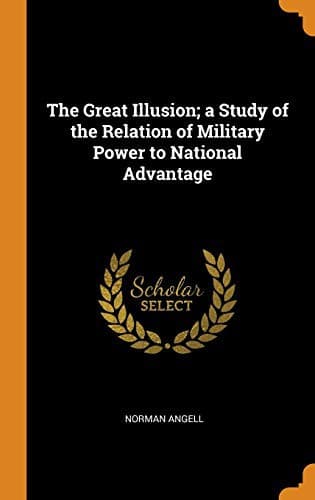
The Great Illusion: A Study of the Relation of Military Power to National AdvantageAngell, Norman
History
The Great Illusion: A Study of the Relation of Military Power to National Advantage
Angell, Norman
Commercial policy; Disarmament; Imperialism; War; War, Cost of
sentiment is meant the common morality that guides us in our
treatment of marriage and of private property. The whole tone
of my book is to urge with all possible emphasis the exact
reverse of such a doctrine; to urge that the morality which has
been by our necessities developed in the society of individuals
must also be applied to the society of nations as that society
becomes by virtue of our development more interdependent.
I have only taken a small portion of your reviewer's article
(which runs to a whole page), and I do not think I am
exaggerating when I say that nearly all of it is as untrue and
as much a distortion of what I really say as the passage from
which I have quoted. What I do attempt to make plain is that
the necessity for defence measures (which I completely
recognize and emphatically counsel) implies on the part of
someone a motive for aggression, and that the motive arises
from the (at present) universal belief in the social and
economic advantages accruing from successful conquest.
I challenged this universal axiom of statecraft and attempted
to show that the mechanical development of the last thirty or
forty years, especially in the means of communication, had
given rise to certain economic phenomena--of which re-acting
bourses and the financial interdependence of the great economic
centres of the world are perhaps the most characteristic--which
render modern wealth and trade intangible in the sense that
they cannot be seized or interfered with to the advantage of a
military aggressor, the moral being, not that self-defence is
out of date, but that aggression is, and that when aggression
ceases, self-defence will be no longer necessary. I urged,
therefore, that in these little-recognized truths might
possibly be found a way out of the armament _impasse_; that if
the accepted motive for aggression could be shown to have no
solid basis, the tension in Europe would be immensely relieved,
and the risk of attack become immeasurably less by reason of
the slackening of the motive for aggression. I asked whether
this series of economic facts--so little realized by the
average politician in Europe, and yet so familiar to at least a
few of the ablest financiers--did not go far to change the
axioms of statecraft, and I urged re-consideration of such in
the light of these facts.
Your reviewer, instead of dealing with the questions thus
raised, accuses me of "attacking patriotism," of arguing that
"Englishmen would be equally happy under German rule," and much
nonsense of the same sort, for which there is not a shadow of
justification. Is this serious criticism? Is it worthy of the
_Spectator_?
To the foregoing letter the _Spectator_ critic rejoins as follows:
Public-domain text, read in full here on John Shaqi.
Reviews
Reviews
No reviews yet
Be the first to share your thoughts on this work.
Elsewhere in the archive
Join the Discussion
Join the discussion
Sign in to leave a comment or review.
Sign InorCreate an account