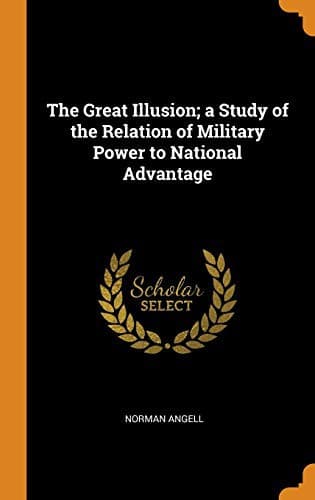
The Great Illusion: A Study of the Relation of Military Power to National AdvantageAngell, Norman
History
The Great Illusion: A Study of the Relation of Military Power to National Advantage
Angell, Norman
Commercial policy; Disarmament; Imperialism; War; War, Cost of
Mr. Angell's main point is that the advantages customarily
associated with national independence and security have no
existence outside the popular imagination.... He holds that
Englishmen would be equally happy if they were under German
rule, and that Germans would be equally happy if they were
under English rule. It is irrational, therefore, to take any
measures for perpetuating the existing European order, since
only a sentimentalist can set any value on its maintenance....
Probably in private life Mr. Angell is less consistent and less
inclined to preach the burglar's gospel that to the wise man
_meum_ and _tuum_ are but two names for the same thing. If he
is anxious to make converts, he will do well to apply his
reasoning to subjects that come nearer home, and convince the
average man that marriage and private property are as much
illusions as patriotism. If sentiment is to be banished from
politics, it cannot reasonably be retained in morals.
As the reply to this somewhat extraordinary criticism is directly
germane to what it is important to make clear, I may, perhaps, be
excused for reproducing my letter to the _Spectator_, which was in part
as follows:
How far the foregoing is a correct description of the scope and
character of the book under review may be gathered from the
following statement of fact. My pamphlet does _not_ attack the
sentiment of patriotism (unless a criticism of the duellist's
conception of dignity be considered as such); it simply does
not deal with it, as being outside the limits of the main
thesis. I do _not_ hold, and there is not one line to which
your reviewer can point as justifying such a conclusion, that
Englishmen would be equally happy if they were under German
rule. I do not conclude that it is irrational to take measures
for perpetuating the existing European order. I do _not_
"expose the folly of self-defence in nations." I do _not_
object to spending money on armaments at this juncture. On the
contrary, I am particularly emphatic in declaring that while
the present philosophy is what it is, we are bound to maintain
our relative position with other Powers. I admit that so long
as there is danger, as I believe there is, from German
aggression, we must arm. I do _not_ preach a burglar's gospel,
that _meum_ and _tuum_ are the same thing, and the whole
tendency of my book is the exact reverse: it is to show that
the burglar's gospel--which is the gospel of statecraft as it
now stands--is no longer possible among nations, and that the
difference between _meum_ and _tuum_ must necessarily, as
society gains in complication, be given a stricter observance
than it has ever heretofore been given in history. I do _not_
urge that sentiment should be banished from politics, if by
Public-domain text, read in full here on John Shaqi.
Reviews
Reviews
No reviews yet
Be the first to share your thoughts on this work.
Elsewhere in the archive
Join the Discussion
Join the discussion
Sign in to leave a comment or review.
Sign InorCreate an account