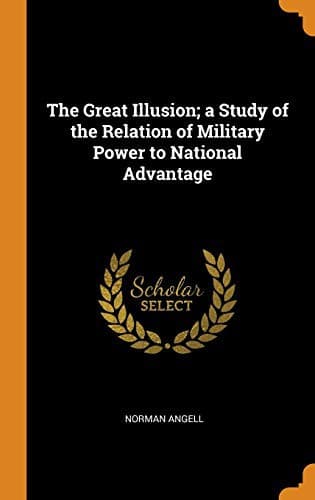
The Great Illusion: A Study of the Relation of Military Power to National AdvantageAngell, Norman
History
The Great Illusion: A Study of the Relation of Military Power to National Advantage
Angell, Norman
Commercial policy; Disarmament; Imperialism; War; War, Cost of
Are we immediately to cease preparation for war, since our
defeat cannot advantage our enemy nor do us in the long run
much harm? No such conclusion results from a study of the
considerations elaborated here. It is evident that so long as
the misconception we are dealing with is all but universal in
Europe, so long as the nations believe that in some way the
military and political subjugation of others will bring with it
a tangible material advantage to the conqueror, we all do, in
fact, stand in danger from such aggression. Not his interest,
but what he deems to be his interest, will furnish the real
motive of our prospective enemy's action. And as the illusion
with which we are dealing does, indeed, dominate all those
minds most active in European politics, we (in England) must,
while this remains the case, regard an aggression, even such as
that which Mr. Harrison foresees, as within the bounds of
practical politics. (What is not within the bounds of
possibility is the extent of devastation which he foresees as
the result of such attack, which, I think, the foregoing pages
sufficiently demonstrate.)
On this ground alone I deem that England, or any other nation,
is justified in taking means of self-defence to prevent such
aggression. This is not, therefore, a plea for disarmament
irrespective of the action of other nations. So long as current
political philosophy in Europe remains what it is, I would not
urge the reduction of the British war budget by a single
sovereign.
I see no reason to alter a word of this. But if preparation of the
machinery of war is to be the only form of energy in this matter--if
national effort is to neglect all other factors whatsoever--more and
more will sincere and patriotic men have doubts as to whether they are
justified in co-operating in further piling up the armaments of any
country. Of the two risks involved--the risk of attack arising from a
possible superiority of armament on the part of a rival, and the risk of
drifting into conflict because, concentrating all our energies on the
mere instrument of combat, we have taken no adequate trouble to
understand the facts of this case--it is at least an arguable
proposition that the second risk is the greater. And I am prompted to
this expression of opinion without surrendering one iota of a lifelong
and passionate belief that a nation attacked should defend itself to the
last penny and to the last man.
Public-domain text, read in full here on John Shaqi.
Reviews
Reviews
No reviews yet
Be the first to share your thoughts on this work.
Elsewhere in the archive
Join the Discussion
Join the discussion
Sign in to leave a comment or review.
Sign InorCreate an account