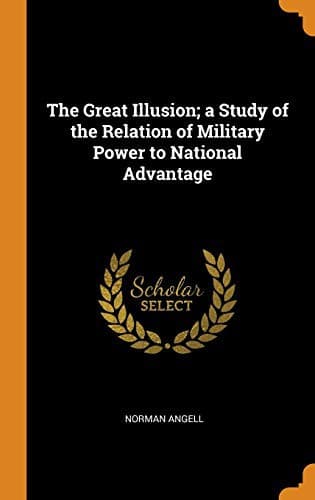
The Great Illusion: A Study of the Relation of Military Power to National AdvantageAngell, Norman
History
The Great Illusion: A Study of the Relation of Military Power to National Advantage
Angell, Norman
Commercial policy; Disarmament; Imperialism; War; War, Cost of
As already pointed out, the last year or two has revealed a suggestive
shifting of position on the part of such opposition. The original
position of the defenders of the old political creeds was that the
economic thesis here outlined was just simply wrong; then, that the
principles themselves were sound enough, but that they were irrelevant,
because not interests, but ideals, constituted the cause of conflict
between nations. In reply to which, of course, came the query, What
ideals, apart from questions of interest, lie at the bottom of the
conflict which is the most typical of our time--what ideal motive is
Germany, for instance, pursuing in its presumed aggression upon England?
Consequently that position has generally been abandoned. Then we were
told that men don't act by logic, but passion. Then the critics were
asked how they explained the general character of _la haute politique_,
its cold intrigues and expediency, the extraordinary rapid changes in
alliances and _ententes_, all following exactly a line of passionless
interest reasoned, though from false premises, with very great logic
indeed; and were asked whether all experience does not show that, while
passion may determine the energy with which a given line of conduct is
pursued, the direction of that line of conduct is determined by
processes of another kind: John, seeing James, his life-long and
long-sought enemy, in the distance, has his hatred passionately stirred,
and harbors thoughts of murder. As he comes near he sees that it is not
James at all, but a quiet and inoffensive neighbor, Peter. John's
thoughts of murder are appeased, not because he has changed his nature,
but because the recognition of a simple fact has changed the direction
of his passion. What we in this matter hope to do is to show that the
nations are mistaking Peter for James.
Well, the last entrenchment of those who oppose the work is the dogmatic
assertion that though we are right as to the material fact, its
demonstration can never be made; that this political reformation of
Europe the political rationalists talk about is a hopeless matter; it
implies a change of opinion so vast that it can only be looked for as
the result of whole generations of educative processes.
Suppose this were true. What then? Will you leave everything severely
alone, and leave wrong and dangerous ideas in undisturbed possession of
the political field?
This conclusion is not a policy; it is Oriental fatalism--"Kismet," "the
will of Allah."
Public-domain text, read in full here on John Shaqi.
Reviews
Reviews
No reviews yet
Be the first to share your thoughts on this work.
Elsewhere in the archive
Join the Discussion
Join the discussion
Sign in to leave a comment or review.
Sign InorCreate an account