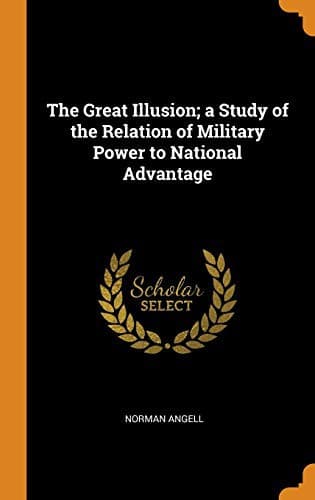
The Great Illusion: A Study of the Relation of Military Power to National AdvantageAngell, Norman
History
The Great Illusion: A Study of the Relation of Military Power to National Advantage
Angell, Norman
Commercial policy; Disarmament; Imperialism; War; War, Cost of
Such an attitude is not possible among men dominated by the traditions
and the impulses of the Western world. We do not let things slide in
this way; we do not assume that as men are not guided by reason in
politics, therefore we shall not reason about politics. The time of
statesmen is absorbed in the discussion of these things. Our press and
literature are deeply concerned in them. The talk and thought of men are
about them. However little they may deem reason to affect the conduct of
men, they go on reasoning. And progress in conduct is determined by the
degree of understanding which results.
It is true that physical conflict marks the point at which the reason
has failed; men fight when they have not been able to "come to an
understanding" in the common phrase, which is for once correct. But is
this a cause for deprecating the importance of clear understanding? Is
it not, on the contrary, precisely why our energies should be devoted to
improving our capacity for dealing with these things by reason, rather
than by physical force?
Do we not inevitably arrive at the destination to which every road in
this discussion leads? However we may start, with whatever plan, however
elaborated or varied, the end is always the same--the progress of man in
this matter depends upon the degree to which his ideas are just; man
advances by the victories of his mind and character. Again we have
arrived at the region of platitude. But also again it is one of those
platitudes which most people deny. Thus the London _Spectator_:
For ourselves, as far as the main economic proposition goes, he
preaches to the converted.... If nations were perfectly wise
and held perfectly sound economic theories, they would
recognize that exchange is the union of forces, and that it is
very foolish to hate or be jealous of your co-operators.... Men
are savage, bloodthirsty creatures ... and when their blood is
up will fight for a word or a sign, or, as Mr. Angell would put
it, for an illusion.
Criticism at the other end of the journalistic scale--that, for
instance, from Mr. Blatchford--is of an exactly similar character. Mr.
Blatchford says:
Mr. Angell may be right in his contention that modern war is
unprofitable to both belligerents. I do not believe it, but he
may be right. But he is wrong if he imagines that his theory
will prevent European war. To prevent European wars it needs
more than the truth of his theory: it needs that the war lords
and diplomatists and financiers and workers of Europe shall
believe the theory.... So long as the rulers of nations believe
that war may be expedient (see Clausewitz), and so long as they
believe they have the power, war will continue.... It will
continue until these men are fully convinced that it will bring
no advantage.
Therefore, argues Mr. Blatchford, the demonstration that war will not
bring advantage is futile.
Public-domain text, read in full here on John Shaqi.
Reviews
Reviews
No reviews yet
Be the first to share your thoughts on this work.
Elsewhere in the archive
Join the Discussion
Join the discussion
Sign in to leave a comment or review.
Sign InorCreate an account