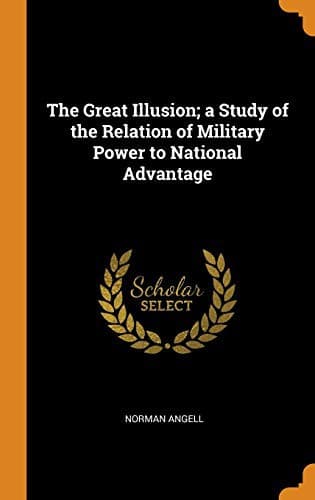
The Great Illusion: A Study of the Relation of Military Power to National AdvantageAngell, Norman
History
The Great Illusion: A Study of the Relation of Military Power to National Advantage
Angell, Norman
Commercial policy; Disarmament; Imperialism; War; War, Cost of
The progress of ideas has completely transformed religious
feeling in so far as it settles the policy of one
religious group in relation to another; _therefore_ the
progress of ideas will never transform patriotic feeling,
which settles the policy of one political group in
relation to another.
What, in short, does the argument of my critics amount to? This: that so
slow, so stupid is the world that, though the facts may be
unassailable, they will never be learned within any period that need
concern us.
Without in the least desiring to score off my critics, and still less to
be discourteous, I sometimes wonder it has never struck them that in the
eyes of the profane this attitude of theirs must appear really as a most
colossal vanity. "We" who write in newspapers and reviews understand
these things; "we" can be guided by reason and wisdom, but the common
clay will not see these truths for "thousands of years." I talk to the
converted (so I am told) when my book is read by the editors and
reviewers. _They_, of course, can understand; but the notion that mere
diplomats and statesmen, the men who make up Governments and nations,
should ever do so is, of course, quite too preposterous.
Personally, however flattering this notion might be, I have never been
able to feel its soundness. I have always strongly felt the precise
opposite--namely, that what is plain to me will very soon be equally
plain to my neighbor. Possessing, presumably, as much vanity as most, I
am, nevertheless, absolutely convinced that simple facts which stare an
ordinary busy man of affairs in the face are not going to be for ever
hid from the multitude. Depend upon it, if "we" can see these things, so
can the mere statesmen and diplomats and those who do the work of the
world.
Moreover, if what "we" write in reviews and books does not touch men's
reasons, does not affect their conduct, why do we write at all?
We do _not_ believe it impossible to change or form men's ideas; such a
plea would doom us all to silence, and would kill religious and
political literature. "Public Opinion" is not external to men; it is
made by men; by what they hear and read and have suggested to them by
their daily tasks, and talk and contact.
If it _were_ true, therefore, that the difficulties in the way of
modifying political opinion were as vast as my critics would have us
believe, that would not affect our conduct; the more they emphasize
those difficulties, the more they emphasize the need for effort on our
part.
Public-domain text, read in full here on John Shaqi.
Reviews
Reviews
No reviews yet
Be the first to share your thoughts on this work.
Elsewhere in the archive
Join the Discussion
Join the discussion
Sign in to leave a comment or review.
Sign InorCreate an account