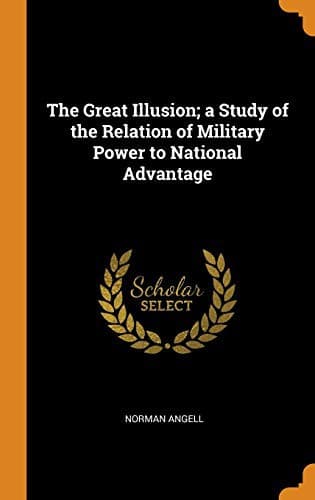
The Great Illusion: A Study of the Relation of Military Power to National AdvantageAngell, Norman
History
The Great Illusion: A Study of the Relation of Military Power to National Advantage
Angell, Norman
Commercial policy; Disarmament; Imperialism; War; War, Cost of
But it is not true that a change such as that involved here necessarily
"takes thousands of years." I have already dealt with the plea, but
would recall only one incident that I have cited: a scene painted by a
Spanish artist of the Court and nobles and populace in a great European
city, gathered on a public holiday as for a festival to see a beautiful
child burned to death for a faith that, as it plaintively said, it had
sucked in with its mother's milk.
How long separates us from that scene? Why, not the lives of three
ordinarily elderly people. And how long after that scene--which was not
an isolated incident of uncommon kind, but a very everyday matter,
typical of the ideas and feelings of the time at which it was
enacted--was it before the renewal of such became a practical
impossibility? It was not a hundred years. It was enacted in 1680, and
within the space of a short lifetime the world knew that never again
would a child be burned alive as the result of a legal condemnation by a
duly constituted Court, and as a public festival, witnessed by the King
and the nobles and the populace, in one of the great cities of Europe.
Or, do those who talk of "unchanging human nature" and "thousands of
years" really plead that we are in danger of a repetition of such a
scene? In that case our religious toleration is a mistake. Protestants
stand in danger of such tortures, and should arm themselves with the old
armory of religious combat--the rack, the thumbscrew, the iron maiden,
and the rest--as a matter of sheer protection.
"Men are savage, bloodthirsty creatures, and will fight for a word or a
sign," the _Spectator_ tells us, when their patriotism is involved.
Well, until yesterday, it was as true to say that of them when their
religion was involved. Patriotism is the religion of politics. And as
one of the greatest historians of religious ideas has pointed out,
religion and patriotism are the chief moral influences moving great
bodies of men, and "the separate modifications and mutual interaction of
these two agents may almost be said to constitute the moral history of
mankind."[120]
Public-domain text, read in full here on John Shaqi.
Reviews
Reviews
No reviews yet
Be the first to share your thoughts on this work.
Elsewhere in the archive
Join the Discussion
Join the discussion
Sign in to leave a comment or review.
Sign InorCreate an account