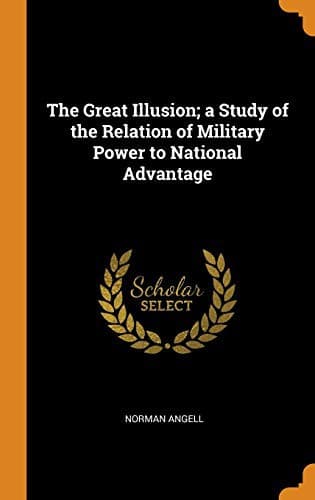
The Great Illusion: A Study of the Relation of Military Power to National AdvantageAngell, Norman
History
The Great Illusion: A Study of the Relation of Military Power to National Advantage
Angell, Norman
Commercial policy; Disarmament; Imperialism; War; War, Cost of
Though he believes his own position in the world (as a colonial Power,
etc.) to be the result of the use of force by himself, of his readiness
to seize what could be seized, he is asked to believe that foreigners
will not do in the future what he himself has done in the past. He finds
this difficult to swallow.
Save in his Sunday moods, the whole thing makes him angry. It appeals to
him as "unfair," in that he is asked by his own countrymen to do
something that they apparently do not ask of foreigners; it appears to
him as unmanly, in that he is asked to surrender the advantage which his
strength has secured him in favor of a somewhat emasculate ideal.
The patriot feels that his moral intention is every bit as sincere as
that of the pacifist--that, indeed, patriotism is a finer moral ideal
than pacifism. The difference between the pacifist and the advocate of
_real-politik_ is an intellectual and not a moral one at all, and the
assumption of superior morality which the former sometimes makes does
the cause which he has at heart infinite harm. Until the pacifist can
show that the employment of military force fails to secure material
advantage, the common man will, in ordinary times, continue to believe
that the militarist has a moral sanction as great as that underlying
pacifism.
It may seem gratuitously ungracious to suggest that the very elevation
which has marked peace propaganda in the past should have been the very
thing that has sometimes stood in the way of its success. But such a
phenomenon is not new in human development. There was as much good
intention in the world of religious warfare and oppression as there is
in ours. Indeed, the very earnestness of the men who burnt, tortured,
and imprisoned and stamped out human thought with the very best motives,
was precisely the factor which stood in the way of improvement.
Improvement came finally, not from better intention, but from an acuter
use of the intelligence of men, from hard mental work.
So long as we assume that high motive, a better moral tone is all that
is needed in international relations, and that an understanding of these
problems will in some wonderful way come of itself, without hard and
systematic intellectual effort, we shall make little headway.
Good feeling and kindliness and a ready emotion are among the most
precious things in life, but they are qualities possessed by some of the
most retrograde nations in the world, because in them they are not
coupled with the homely quality of hard work, in which one may include
hard thinking. This last is the real price of progress, and we shall
make none of worth unless we pay it.
Public-domain text, read in full here on John Shaqi.
Reviews
Reviews
No reviews yet
Be the first to share your thoughts on this work.
Elsewhere in the archive
Join the Discussion
Join the discussion
Sign in to leave a comment or review.
Sign InorCreate an account