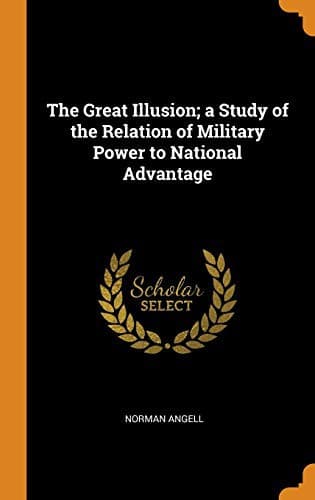
The Great Illusion: A Study of the Relation of Military Power to National AdvantageAngell, Norman
History
The Great Illusion: A Study of the Relation of Military Power to National Advantage
Angell, Norman
Commercial policy; Disarmament; Imperialism; War; War, Cost of
"Well, in these islands, not so very long ago, those things
were causes of bloodshed; indeed, they were a common feature of
European life. But if they are inevitable in human
relationship, how comes it that Adana is no longer duplicated
by St. Bartholomew; the Bulgarian bands by the vendetta of the
Highlander and the Lowlander; the struggle of the Slav and
Turk, Serb and Bulgar, by that of Scots and English, and
English and Welsh? The fanaticism of the Moslem to-day is no
more intense than that of Catholic and heretic in Rome, Madrid,
Paris, and Geneva at a time which is only separated from us by
the lives of three or four elderly men. The heretic or infidel
was then in Europe also a thing unclean and horrifying,
exciting in the mind of the orthodox a sincere and honest
hatred and a (very largely satisfied) desire to kill. The
Catholic of the 16th century was apt to tell you that he could
not sit at table with a heretic because the latter carried with
him a distinctive and overpoweringly repulsive odor. If you
would measure the distance Europe has travelled, think what
this means: all the nations of Christendom united in a war
lasting 200 years for the capture of the Holy Sepulchre; and
yet, when in our day their representatives, seated round a
table, could have had it for the asking, they did not deem it
worth the asking, so little of the ancient passion was there
left. The very nature of man seemed to be transformed. For,
wonderful though it be that orthodox should cease killing
heretic, infinitely more wonderful still is it that he should
cease wanting to kill him.
"Just as most of us are certain that the underlying causes of
this conflict are 'inevitable' and 'inherent in unchanging
human nature,' so are we certain that so _un_-human a thing as
economics can have no bearing on it.
"Well, I will suggest that the transformation of the
heretic-hating and heretic-killing European is due mainly to
economic forces; that it is because the drift of those forces
has to so great a degree left the Balkans, where until
yesterday the people lived a life little different from that
which they lived in the time of Abraham, unaffected that war is
now raging; that economic factors of a more immediate kind form
a large part of the provoking cause of that war; and that a
better comprehension by great nations of Europe of certain
economic facts of their international relationship is essential
before much progress towards solution can be made.
"But then by 'economics' of course I mean, not a merchant's
profit or a money-lender's interest, but the method by which
men earn their bread, which must also mean the kind of life
they lead.
Public-domain text, read in full here on John Shaqi.
Reviews
Reviews
No reviews yet
Be the first to share your thoughts on this work.
Elsewhere in the archive
Join the Discussion
Join the discussion
Sign in to leave a comment or review.
Sign InorCreate an account