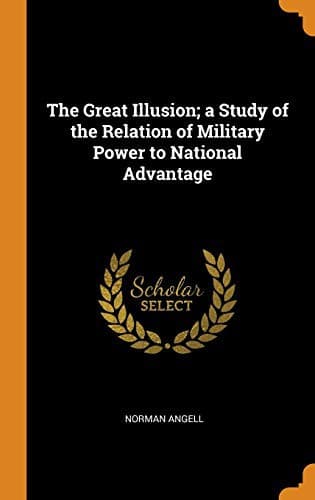
The Great Illusion: A Study of the Relation of Military Power to National AdvantageAngell, Norman
History
The Great Illusion: A Study of the Relation of Military Power to National Advantage
Angell, Norman
Commercial policy; Disarmament; Imperialism; War; War, Cost of
"We generally think of the primitive life of man--that of the
herdsman or the tent liver--as something idyllic. The picture
is as far as possible from the truth. Those into whose lives
economics do not enter, or enter very little--that is to say,
those who, like the Congo cannibal, or the Red Indian, or the
Bedouin, do not cultivate, or divide their labor, or trade, or
save, or look to the future, have shed little of the primitive
passions of other animals of prey, the tigers and the wolves,
who have no economics at all, and have no need to check an
impulse or a hate. But industry, even of the more primitive
kind, means that men must divide their labor, which means that
they must put some sort of reliance upon one another; the thing
of prey becomes a partner, and the attitude towards it changes.
And as this life becomes more complex, as the daily needs and
desires push men to trade and barter, that means building up a
social organization, rules and codes and courts to enforce
them; as the interdependence widens and deepens it necessarily
means the cessation of certain hostilities. If the neighboring
tribe wants to trade with you it must not kill you; if you want
the services of the heretic you must not kill him, you must
keep your obligation towards him, and mutual good faith is
death to long-sustained hatreds.
"You cannot separate the moral from the social and economic
development of a people. The great service of a complex social
and industrial organization, which is built up by the desire of
men for better material conditions, is not that it 'pays,' but
that it makes a more interdependent human society, and that it
leads men to recognize what is the best relationship among
them. The fact of recognizing that some act of aggression is
causing stocks to fall is not important because it may save
Oppenheim's or Solomon's money but because it is a
demonstration that we are dependent upon some community on the
other side of the world, that their damage is our damage, and
that we have an interest in preventing it. It teaches us, as
only some such simple and mechanical means can teach, the
lesson of human fellowship.
"It is by such means as this that Western Europe has in some
measure, within its respective political frontiers, learned
that lesson. Each nation has learned, within its own confines
at least, that wealth is made by work, not robbery; that,
indeed, general robbery is fatal to prosperity; that government
consists not merely in having the power of the sword but in
organizing society--in 'knowing how,' which means the
development of ideas; in maintaining courts; in making it
possible to run railways, post-offices, and all the
contrivances of a complex society.
Public-domain text, read in full here on John Shaqi.
Reviews
Reviews
No reviews yet
Be the first to share your thoughts on this work.
Elsewhere in the archive
Join the Discussion
Join the discussion
Sign in to leave a comment or review.
Sign InorCreate an account