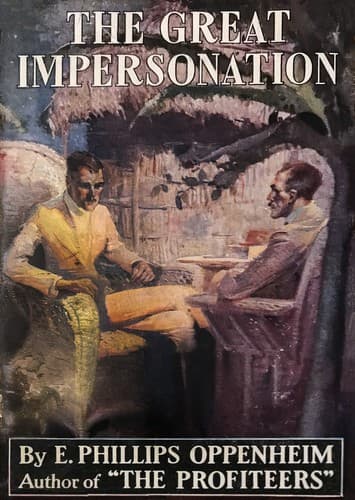
The Great ImpersonationOppenheim, E. Phillips (Edward Phillips)
General
The Great Impersonation
Oppenheim, E. Phillips (Edward Phillips)
Spy stories
“I have worked for peace,” Terniloff went on, “believing that my
country wanted peace. I have worked for peace with honourable men who
were just as anxious as I was to secure it. But all the time those for
whom I laboured were making faces behind my back. I was nothing more
nor less than their tool. I know now that nothing in this world could
have hindered what is coming.”
“Every one will at least realise,” Dominey reminded him, “that you did
your best for peace.”
“That is one reason why I sent for you,” was the agitated reply. “Not
long ago I spoke of a little volume, a diary which I have been keeping
of my work in this country. I promised to show it to you. You have asked
me for it several times lately. I am going to show it to you now. It is
written up to yesterday. It will tell you of all my efforts and how they
were foiled. It is an absolutely faithful narrative of my work here, and
the English response to it.”
The Prince crossed the room, unlocked one of the smaller safes, which
stood against the side of the wall, withdrew a morocco-bound volume the
size of a small portfolio, and returned to Dominey.
“I beg you,” he said earnestly, “to read this with the utmost care and
to await my instructions with regard to it. You can judge, no doubt,”
he went on a little bitterly, “why I give it into your keeping. Even
the Embassy here is not free from our own spies, and the existence of
these memoirs is known. The moment I reach Germany, their fate is
assured. I am a German and a patriot, although my heart is bitter
against those who are bringing this blot upon our country. For that
reason, these memoirs must be kept in a safe place until I see a good
use for them.”
“You mean if the governing party in German should change?”
“Precisely! They would then form at once my justification, and place
English diplomacy in such a light before the saner portion of my fellow
countrymen that an honourable peace might be rendered possible. Study
them carefully, Von Ragastein. Perhaps even your own allegiance to the
Party you serve may waver for a moment as you read.”
“I serve no Party,” Dominey said quietly, “only my Country.”
Terniloff sighed.
“Alas! there is no time for us to enter into one of our old arguments on
the ethics of government. I must send you away, Von Ragastein. You have
a terrible task before you. I am bound to wish you Godspeed. For myself
I shall not raise my head again until I have left England.”
“There is no other commission?” Dominey asked. “No other way in which I
can serve you?”
“None,” Terniloff answered sadly. “I am permitted to suffer no
inconveniences. My departure is arranged for as though I were royalty.
Yet believe me, my friend, every act of courtesy and generosity which I
receive in these moments, bites into my heart. Farewell!”
Dominey found a taxicab in Pall Mall and drove back to Berkeley Square.
He found Rosamund with a little troop of dogs, just entering the
gardens, and crossed to her side.
Public-domain text, read in full here on John Shaqi.
Reviews
Reviews
No reviews yet
Be the first to share your thoughts on this work.
Elsewhere in the archive
Join the Discussion
Join the discussion
Sign in to leave a comment or review.
Sign InorCreate an account