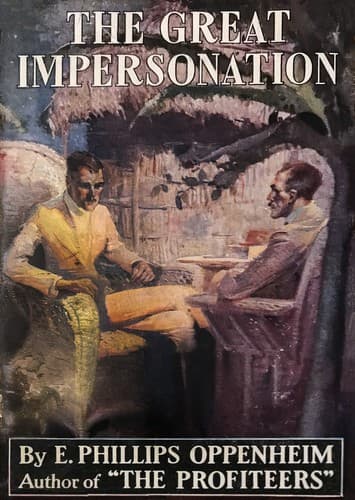
The Great ImpersonationOppenheim, E. Phillips (Edward Phillips)
General
The Great Impersonation
Oppenheim, E. Phillips (Edward Phillips)
Spy stories
“Dear,” he asked, taking her arm, “would you mind very much coming down
to Norfolk for a few days?”
“With you?” she asked quickly.
“Yes! I want to be in retreat for a short time. There are one or two
things I must settle before I take up some fresh work.”
“I should love it,” she declared enthusiastically. “London is getting so
hot, and every one is so excited.”
“I shall order the touring car at three o'clock,” Dominey told her. “We
shall get home about nine. Parkins and your maid can go down by train.
Does that suit you?”
“Delightfully!”
He took her arm and they paced slowly along the hot walk.
“Rosamund dear,” he said, “the time has come which many people have been
dreading. We are at war.”
“I know,” she murmured.
“You and I have had quite a happy time together, these last few months,”
he went on, “even though there is still that black cloud between us. I
have tried to treat you as kindly and tenderly as though I were really
your husband and you were indeed my wife.”
“You're not going away?” she cried, startled. “I couldn't bear that! No
one could ever be so sweet as you have been to me.”
“Dear,” he said, “I want you to think--of your husband--of Everard. He
was a soldier once for a short time, was he not? What do you think he
would have done now that this terrible war has come?”
“He would have done what you will do,” she answered, with the slightest
possible tremor in her tone. “He would have become a soldier again, he
would have fought for his country.”
“And so must I--fight for my country,” he declared. “That is why I must
leave you for an hour now while I make some calls. I shall be back
to luncheon. Directly afterwards we must start. I have many things to
arrange first, though. Life is not going to be very easy for the next
few days.”
She held on to his arm. She seemed curiously reluctant to let him go.
“Everard,” she said, “when we are at Dominey shall I be able to see
Doctor Harrison?”
“Of course,” he assured her.
“There is something I want to say to him,” she confided, “something I
want to ask you, too. Are you the same person, Everard, when you are in
town as when you are in the country?”
He was a little taken aback at her question--asked, too, with such
almost plaintive seriousness. The very aberration it suggested seemed
altogether denied by her appearance. She was wearing a dress of black
and white muslin, a large black hat, Paris shoes. Her stockings, her
gloves, all the trifling details of her toilette, were carefully chosen,
and her clothes themselves gracefully and naturally worn. Socially, too,
she had been amazingly successful. Only the week before, Caroline had
come to him with a little shrug of the shoulders.
“I have been trying to be kind to Rosamund,” she said, “and finding
out instead how unnecessary it is. She is quite the most popular of the
younger married women in our set. You don't deserve such luck, Everard.”
“You know the proverb about the old roue,” he had replied.
Public-domain text, read in full here on John Shaqi.
Reviews
Reviews
No reviews yet
Be the first to share your thoughts on this work.
Elsewhere in the archive
Join the Discussion
Join the discussion
Sign in to leave a comment or review.
Sign InorCreate an account