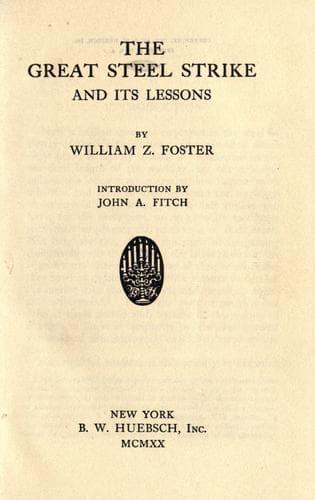
The Great Steel Strike and its LessonsFoster, William Z.
History
The Great Steel Strike and its Lessons
Foster, William Z.
Steel Strike, U.S., 1919-1920; United States Steel Corporation
Throughout the hearings the investigating senators went along with this
Steel Trust propaganda, which was not so surprising considering the fact
that of the five active committee men, one was a steel magnate, and
three others typical Bourbons. By playing up the "little red book" they
systematically fed the newspapers with the sensationalism they wanted
and which the steel companies desired them to get. I was called before
the Committee and gruffly ordered to express my opinion on the doctrines
in the booklet. In reply, I stated that the steel movement had been
carried on according to the strictest trade-union principles. It was
overseen by the National Committee, consisting of twenty-four
presidents of large international unions. As secretary of this committee
I had necessarily worked under the close scrutiny of these men and
dozens of their organizers--not to speak of the highest officials in the
American Federation of Labor. Yet none of these trade unionists, keen
though they be to detect and condemn unusual practices and heresy in the
ranks, had found fault with the character of my work. Nor could the crew
of detectives and stool pigeons of the steel companies and Department of
Justice, who had dogged my footsteps for a year past, cite a single word
said, a thing done, or a line written by me in the entire campaign which
would not measure up to most rigid trade-union standards. I contended
that my private opinions were immaterial as they did not and could not
enter into the organizing work or the strike.
But the nation-wide head hunt of the radicals was on in full cry, and
the Senators had a good blood scent. They would follow it to the end.
They insisted that I express my opinion upon the wage system, the state,
morality, patriotism, marriage, etc. Finally, in a last effort to
protect the interests of the 2,000,000 men, women and children affected
by the strike, I stated that if the vulture press, which was bound to
misrepresent what I said, was removed from the room, I would be glad to
oblige the Senators with a frank expression of my views upon any
subject. But this simple fairness to the steel workers and their
families they denied. The newspapers were clamoring for red meat, and
the Senators seemed determined they should have it. Having made my
protest and my prediction, I was compelled to yield; but the first
newspapers on the streets proved the soundness of my fears. My answers
were garbled and twisted against both the steel movement and me.
Public-domain text, read in full here on John Shaqi.
Reviews
Reviews
No reviews yet
Be the first to share your thoughts on this work.
Elsewhere in the archive
Join the Discussion
Join the discussion
Sign in to leave a comment or review.
Sign InorCreate an account