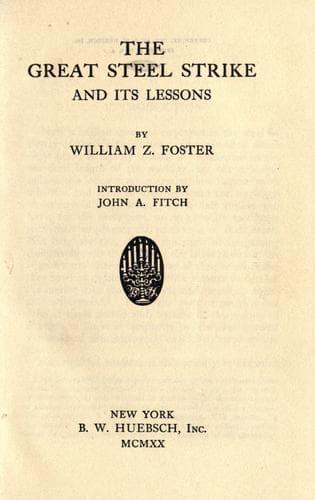
The Great Steel Strike and its LessonsFoster, William Z.
History
The Great Steel Strike and its Lessons
Foster, William Z.
Steel Strike, U.S., 1919-1920; United States Steel Corporation
Although they expressed great concern for the sufferings of the public
in strikes, and advocated the establishment of an industrial tribunal to
prevent them in the future, the worthy Senators, nevertheless,
recommended no means to end the steel strike. So far as they were
concerned, apparently they were willing to have the steel strike fought
to a conclusion. At one of the Senate Committee hearings, John
Fitzpatrick, Chairman of the National Committee, agreed to arbitration.
But later Mr. Gary gave an emphatic "No" to this proposition. Mr. Gary's
wishes usually had decisive weight with the Senators, so the matter was
settled.
On October 1-3, 1919, a national conference called by the Industrial
Relations Department of the Interchurch World Movement met at the Hotel
Pennsylvania in New York and adopted a resolution providing for a full
investigation of the steel strike, then a burning public question. Under
the terms of this resolution the Industrial Relations Department set up
an independent Commission of Inquiry, composed of representative
churchmen from all over the country who should be responsible for
carrying out the investigation. This Commission consisted of Bishop
Francis J. McConnell (Methodist), Chairman, Dr. Daniel A. Poling
(Evangelical), vice-Chairman, Dr. John McDowell (Presbyterian), Mrs.
Fred Bennett (Board of Foreign Missions), Dr. Nicholas Van Der Pyl
(Congregational), Dr. Alva W. Taylor (Disciples), and Mr. Geo. W.
Coleman (Baptist).
In order to commit the investigation of technical data to the hands of
trained men, the Industrial Relations Department obtained the services
of the Bureau of Industrial Research, New York, which, besides its own
researches, obtained the co-operation of various other scientific
agencies and organized a staff of field workers whose principal members
were: Mr. George Soule, Mr. David J. Saposs, Miss Marian D. Savage, Mr.
Marion K. Wisehart and Mr. Robert Littell. A member of the Bureau of
Industrial Research, Mr. Heber Blankenhorn, had charge of the field work
and later acted as Secretary to the Commission of Inquiry, which held
hearings in Pittsburgh, Chicago, and other steel centres.
The Interchurch World Movement, representing as it does the organized
Protestant millions of America, is a conservative and respectable body,
if there is such in this country. Yet when it stepped upon the toes of
the Steel Trust by starting the investigation it found itself soon
classed among the revolutionaries. Persistent rumors were sent
broadcast, and even newspaper stories, to the effect that the
Commission's investigators were "Bolsheviks" and that the Interchurch
World Movement was permeated with "anarchists." This hampered the work
greatly, especially among employers. Finally a threat of legal action
was necessary against a large commercial organization which had
circulated the rumors officially. It eventually retracted in full. As
for the workers, they gave the fullest co-operation to the
investigation.
Public-domain text, read in full here on John Shaqi.
Reviews
Reviews
No reviews yet
Be the first to share your thoughts on this work.
Elsewhere in the archive
Join the Discussion
Join the discussion
Sign in to leave a comment or review.
Sign InorCreate an account