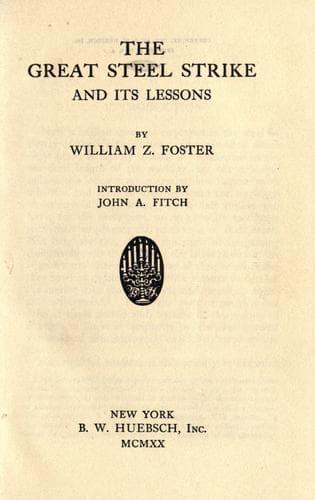
The Great Steel Strike and its LessonsFoster, William Z.
History
The Great Steel Strike and its Lessons
Foster, William Z.
Steel Strike, U.S., 1919-1920; United States Steel Corporation
In the Bethlehem Steel Company's plants the strike was not very
effective. This was due principally to the failure of previous strikes
and to general lack of organization. In Reading and in Lebanon there had
been strikes on for many weeks before the big walkout. The workers'
ranks there were already broken. In Sparrows' Point likewise several
departments had been on strike since May 3. Not more than 500 men,
principally laborers and tin mill workers, responded to the general
strike call; but they made a hard fight of it. In Steelton the men had
been very strongly organized during the war; but the error was made of
putting all the trades into one federal union. Then when the craft
unions insisted later that their men be turned over to them, the
resultant resistance of the members, and especially of the paid
officers, virtually destroyed the organization. When the strike came
only a small percentage struck, nor did they stick long.
Speaking of the strike in the main plant at Bethlehem, Secretary
Hendricks says:
The strike was called September 29, and about 75 per cent.
of the men responded. These were largely American workers.
The Machinists, which comprise about 40 per cent. of the
total workers, were the craft most involved. In the mill and
blast furnace departments, the response was among the
rollers, heaters, and highly skilled men generally, which
led to the complete shut-down of these departments. The
molders practically shut the foundries down. Electrical
workers, steamfitters, millwrights, and general repairmen
responded well. The patternmakers did not go out.
The first break came a week later. It was charged largely to the steam
engineers, who heeded the strike-breaking advice of their international
officials and returned to work. Another factor was the failure of
support from the railroad men on the inter-plant system. Had these two
bodies of men been held in line by their officers, the Bethlehem strike
would have been a success.
In the Bethlehem situation too much reliance was placed in the skilled
trades; more attention should have been given to the organization of the
real fighting force, the unskilled workers. Another mistake was to have
allowed the strikes to take place in Reading, Lebanon and Sparrows'
Point. Even a tyro could see that they had no hope of success. Those
men could easily have been held in line until the big strike, to the
enormous strengthening of the latter. The National Committee had little
to do with the Bethlehem situation before the strike, the movement
developing to a great extent independently.
Public-domain text, read in full here on John Shaqi.
Reviews
Reviews
No reviews yet
Be the first to share your thoughts on this work.
Elsewhere in the archive
Join the Discussion
Join the discussion
Sign in to leave a comment or review.
Sign InorCreate an account