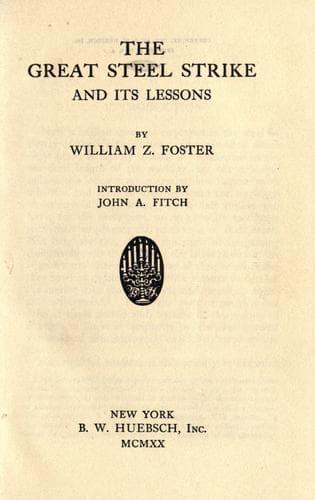
The Great Steel Strike and its LessonsFoster, William Z.
History
The Great Steel Strike and its Lessons
Foster, William Z.
Steel Strike, U.S., 1919-1920; United States Steel Corporation
Nowhere in the strike zone was there a more bitter fight than in the
Buffalo district, which was directed by organizers Thompson and
Streifler. All the important plants were affected, but the storm
centered around the Lackawanna Steel Company. This concern left nothing
undone to defeat its workers. For eight months it had prevented any
meetings from being held in Lackawanna, and then, when the workers broke
through this obstruction and crowded into the unions, it discharged
hundreds of them. This put the iron into the workers' hearts, and they
made an heroic struggle. So firm were their ranks that when the general
strike was called off on January 8, they voted to continue the fight in
Lackawanna. But this was soon seen to be hopeless.
Much company violence was used in the Lackawanna strike. The New York
State Constabulary and the company guards, of a cut with their odious
Pennsylvania brethren, slugged, shot and jailed men and women in real
Steel Trust style. Many strikers were injured, and two killed outright.
One of these, Joseph Mazurek, a native-born American, was freshly back
from the fighting in France. Lackawanna was just a little bit of an
industrial hell.[16]
As a strike measure the Lackawanna Steel Company evicted many strikers
from the company houses. In Braddock, Rankin, Homestead, Butler,
Wierton, Natrona, Bethlehem and many other places, the companies put
similar pressure upon their men, either evicting them or foreclosing the
mortgages on their half-paid-for houses. Threats of such action drove
thousands back to work, it being peculiarly terrifying to workers to
find themselves deprived of their homes in winter time. Where evictions
actually occurred the victims usually had to leave town or find crowded
quarters with other strikers. The much-lauded housing schemes of the
steel companies are merely one of a whole arsenal of weapons to crush
the independence of their workers. No employer should be permitted to
own or control the houses in which his men live.
* * * * *
The Wheeling district is noted as strong union country. The
"independent" mills therein had provided the main strength of the
Amalgamated Association for several years prior to this movement; but
the Trust mills were still unorganized. Under the guidance of National
Committee local secretary J. M. Peters, however, these men, in the mills
of Wheeling, Bellaire, Benwood and Martin's Ferry, were brought into the
unions. On September 22 they struck 100 per cent., completely closing
all the plants. They held practically solid until the first week in
December, when they broke heavily.
Public-domain text, read in full here on John Shaqi.
Reviews
Reviews
No reviews yet
Be the first to share your thoughts on this work.
Elsewhere in the archive
Join the Discussion
Join the discussion
Sign in to leave a comment or review.
Sign InorCreate an account