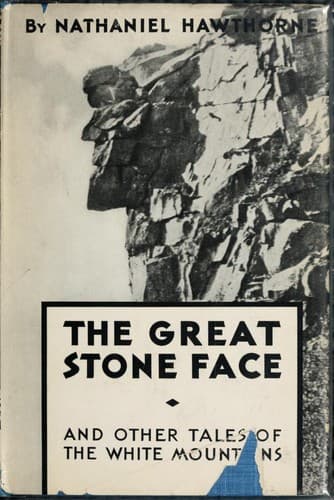
The Great Stone Face, and Other Tales of the White MountainsHawthorne, Nathaniel
General
The Great Stone Face, and Other Tales of the White Mountains
Hawthorne, Nathaniel
Historical fiction, American; Old Man of the Mountain (N.H.) -- Fiction; Short stories; White Mountains (N.H. and Me.) -- Fiction
On the day of the great festival, Ernest, with all the other people of
the valley, left their work, and proceeded to the spot where the sylvan
banquet was prepared. As he approached, the loud voice of the Rev. Dr.
Battleblast was heard, beseeching a blessing on the good things set
before them, and on the distinguished friend of peace in whose honor
they were assembled. The tables were arranged in a cleared space of the
woods, shut in by the surrounding trees, except where a vista opened
eastward, and afforded a distant view of the Great Stone Face. Over the
general’s chair, which was a relic from the home of Washington, there
was an arch of verdant boughs, with the laurel profusely intermixed,
and surmounted by his country’s banner, beneath which he had won his
victories. Our friend Ernest raised himself on his tiptoes, in hopes
to get a glimpse of the celebrated guest; but there was a mighty crowd
about the tables anxious to hear the toasts and speeches, and to catch
any word that might fall from the general in reply; and a volunteer
company, doing duty as a guard, pricked ruthlessly with their bayonets
at any particularly quiet person among the throng. So Ernest, being of
an unobtrusive character, was thrust quite into the background, where he
could see no more of Old Blood-and-Thunder’s physiognomy than if it had
been still blazing on the battlefield. To console himself, he turned
towards the Great Stone Face, which, like a faithful and long-remembered
friend, looked back and smiled upon him through the vista of the forest.
Meantime, however, he could overhear the remarks of various individuals,
who were comparing the features of the hero with the face on the distant
mountainside.
‘’T is the same face, to a hair!’ cried one man, cutting a caper for joy.
‘Wonderfully like, that’s a fact!’ responded another.
‘Like! why, I call it Old Blood-and-Thunder himself, in a monstrous
looking-glass!’ cried a third.
‘And why not? He’s the greatest man of this or any other age, beyond a
doubt.’
And then all three of the speakers gave a great shout, which
communicated electricity to the crowd, and called forth a roar from a
thousand voices, that went reverberating for miles among the mountains,
until you might have supposed that the Great Stone Face had poured
its thunder-breath into the cry. All these comments, and this vast
enthusiasm, served the more to interest our friend; nor did he think of
questioning that now, at length, the mountain-visage had found its human
counterpart. It is true, Ernest had imagined that this long-looked-for
personage would appear in the character of a man of peace, uttering
wisdom, and doing good, and making people happy. But, taking an habitual
breadth of view, with all his simplicity, he contended that providence
should choose its own method of blessing mankind, and could conceive
that this great end might be effected even by a warrior and a bloody
sword, should inscrutable wisdom see fit to order matters SO.
Public-domain text, read in full here on John Shaqi.
Reviews
Reviews
No reviews yet
Be the first to share your thoughts on this work.
Join the Discussion
Join the discussion
Sign in to leave a comment or review.
Sign InorCreate an account