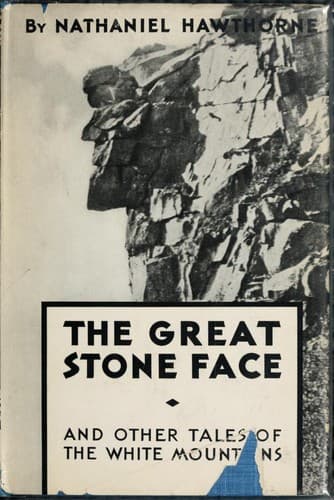
The Great Stone Face, and Other Tales of the White MountainsHawthorne, Nathaniel
General
The Great Stone Face, and Other Tales of the White Mountains
Hawthorne, Nathaniel
Historical fiction, American; Old Man of the Mountain (N.H.) -- Fiction; Short stories; White Mountains (N.H. and Me.) -- Fiction
More years sped swiftly and tranquilly away. Ernest still dwelt in
his native valley, and was now a man of middle age. By imperceptible
degrees, he had become known among the people. Now, as heretofore, he
labored for his bread, and was the same simple-hearted man that he had
always been. But he had thought and felt so much, he had given so many
of the best hours of his life to unworldly hopes for some great good to
mankind, that it seemed as though he had been talking with the angels,
and had imbibed a portion of their wisdom unawares. It was visible in
the calm and well-considered beneficence of his daily life, the quiet
stream of which had made a wide green margin all along its course. Not
a day passed by, that the world was not the better because this man,
humble as he was, had lived. He never stepped aside from his own path,
yet would always reach a blessing to his neighbor. Almost involuntarily,
too, he had become a preacher. The pure and high simplicity of his
thought, which, as one of its manifestations, took shape in the good
deeds that dropped silently from his hand, flowed also forth in speech.
He uttered truths that wrought upon and moulded the lives of those who
heard him. His auditors, it may be, never suspected that Ernest, their
own neighbor and familiar friend, was more than an ordinary man; least
of all did Ernest himself suspect it; but, inevitably as the murmur of
a rivulet, came thoughts out of his mouth that no other human lips had
spoken.
When the people’s minds had had a little time to cool, they were ready
enough to acknowledge their mistake in imagining a similarity between
General Blood-and-Thunder’s truculent physiognomy and the benign visage
on the mountain-side. But now, again, there were reports and many
paragraphs in the newspapers, affirming that the likeness of the Great
Stone Face had appeared upon the broad shoulders of a certain eminent
statesman. He, like Mr. Gathergold and old Blood-and-Thunder, was a
native of the valley, but had left it in his early days, and taken up
the trades of law and politics. Instead of the rich man’s wealth and
the warrior’s sword, he had but a tongue, and it was mightier than both
together. So wonderfully eloquent was he, that whatever he might choose
to say, his auditors had no choice but to believe him; wrong looked like
right, and right like wrong; for when it pleased him, he could make a
kind of illuminated fog with his mere breath, and obscure the natural
daylight with it. His tongue, indeed, was a magic instrument: sometimes
it rumbled like the thunder; sometimes it warbled like the sweetest
music. It was the blast of war--the song of peace; and it seemed to have
a heart in it, when there was no such matter. In good truth, he was a
wondrous man; and when his tongue had acquired him all other imaginable
success--when it had been heard in halls of state, and in the courts of
princes and potentates--after it had made him known all over the world,
Public-domain text, read in full here on John Shaqi.
Reviews
Reviews
No reviews yet
Be the first to share your thoughts on this work.
Join the Discussion
Join the discussion
Sign in to leave a comment or review.
Sign InorCreate an account