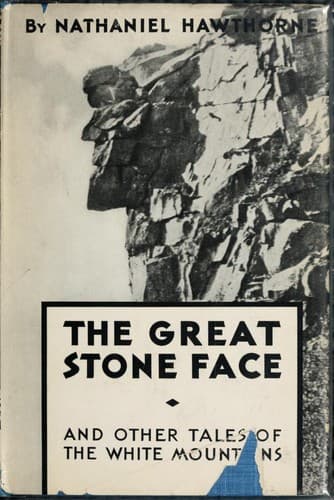
The Great Stone Face, and Other Tales of the White MountainsHawthorne, Nathaniel
General
The Great Stone Face, and Other Tales of the White Mountains
Hawthorne, Nathaniel
Historical fiction, American; Old Man of the Mountain (N.H.) -- Fiction; Short stories; White Mountains (N.H. and Me.) -- Fiction
As touching the other pilgrims of the Great Carbuncle, the legend goes
on to tell, that the worshipful Master Ichabod Pigsnort soon gave up the
quest as a desperate speculation, and wisely resolved to betake himself
again to his warehouse, near the town dock, in Boston. But, as he passed
through the Notch of the mountains, a war party of Indians captured
our unlucky merchant, and carried him to Montreal, there holding him
in bondage, till, by the payment of a heavy ransom, he had woefully
subtracted from his hoard of pine-tree shillings. By his long absence,
moreover, his affairs had become so disordered that, for the rest of his
life, instead of wallowing in silver, he had seldom a sixpence worth
of copper. Doctor Cacaphodel, the alchemist, returned to his laboratory
with a prodigious fragment of granite, which he ground to powder,
dissolved in acids, melted in the crucible, and burned with the
blow-pipe, and published the result of his experiments in one of the
heaviest folios of the day. And, for all these purposes, the gem itself
could not have answered better than the granite. The poet, by a somewhat
similar mistake, made prize of a great piece of ice, which he found in
a sunless chasm of the mountains, and swore that it corresponded, in all
points, with his idea of the Great Carbuncle. The critics say, that, if
his poetry lacked the splendor of the gem, it retained all the coldness
of the ice. The Lord de Vere went back to his ancestral hall, where
he contented himself with a wax-lighted chandelier, and filled, in due
course of time, another coffin in the ancestral vault. As the funeral
torches gleamed within that dark receptacle, there was no need of the
Great Carbuncle to show the vanity of earthly pomp.
The Cynic, having cast aside his spectacles, wandered about the world,
a miserable object, and was punished with an agonizing desire of light,
for the wilful blindness of his former life. The whole night long, he
would lift his splendor-blasted orbs to the moon and stars; he turned
his face eastward, at sunrise, as duly as a Persian idolater; he made
a pilgrimage to Rome, to witness the magnificent illumination of St.
Peter’s Church; and finally perished in the great fire of London, into
the midst of which he had thrust himself, with the desperate idea of
catching one feeble ray from the blaze that was kindling earth and
heaven.
Public-domain text, read in full here on John Shaqi.
Reviews
Reviews
No reviews yet
Be the first to share your thoughts on this work.
Join the Discussion
Join the discussion
Sign in to leave a comment or review.
Sign InorCreate an account