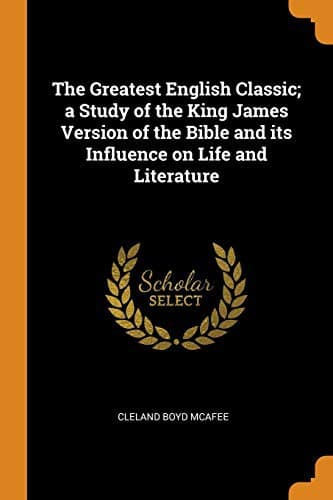
The Greatest English Classic: A Study of the King James Version of the Bible and Its Influence on Life and LiteratureMcAfee, Cleland Boyd
History
The Greatest English Classic: A Study of the King James Version of the Bible and Its Influence on Life and Literature
McAfee, Cleland Boyd
Bible -- History; Bible -- Influence; Bible and literature; Bible. English -- Versions -- Authorized
George Washington sounded a familiar note
in his farewell address: "Of all the dispositions
and habits which lead to political prosperity,
religion and morality are indispensable supports.
A volume could not trace all their connection
with private and public felicity. Let us with
caution indulge the supposition that morality
can be maintained without religion. Whatever
may be conceded to the influence of refined education
on minds of peculiar structure, reason and
experience both forbid us to expect that national
morality can prevail in exclusion of religious
principles." Thomas Jefferson, of whom it is
sometimes said that he was indifferent to religion,
had yet done his great work under inspiration,
which he himself acknowledges in his
inaugural address, when he speaks of the nation
as "enlightened by a benign religion, professed
indeed, and practised in various forms, yet all
of them inculcating honesty, truth, temperance,
gratitude, and the love of man; acknowledging
and adoring an overruling Providence, which
by all its dispensation proves that it results in
the happiness of man here and his greater happiness
hereafter." Greater than Jefferson had
appeared John Marshall, greatest of our Chief
Justices, like in spirit to that John Marshall
Harlan, whose death marked the year which
has just closed, of whom his colleagues said that
he went to his rest each night with one hand on
the Bible and the other on the Constitution of
the United States, a description which could
almost be transferred to his great predecessor
in that court. Moreover, when Lincoln came,
Joseph Story, the greatest teacher of law which
our country had produced, had only just died
from his place on the Supreme Bench, In his
Phi Beta Kappa address at Harvard (1826), in
a brilliant and masterful analysis of "The
Characteristics of the Age," he had paid tribute after
tribute to the power of religion and the Bible.
He had declared his belief that the religion of
the Bible had "established itself in the hearts
of men by all which genius could bring to illumine
or eloquence to grace its sublime truths." Of
the same period with Lincoln was also Webster,
who was called the "concordance of the House."
Many of his stately periods and great ideas came
from the Bible. Indeed, there is no oratory of
our history, which has survived the waste of the
years, which does not feel and show the power
of the Scriptures. The English Bible has given
our finest eloquence its ideas, its ideals, its
illustrations, its phrases.
Public-domain text, read in full here on John Shaqi.
Reviews
Reviews
No reviews yet
Be the first to share your thoughts on this work.
Elsewhere in the archive
Join the Discussion
Join the discussion
Sign in to leave a comment or review.
Sign InorCreate an account