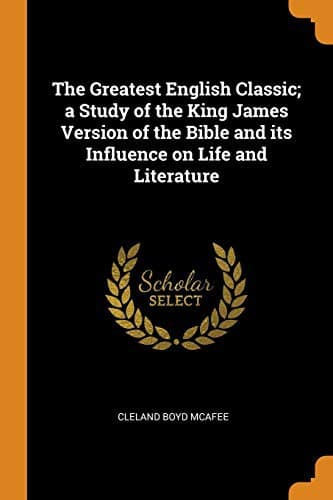
The Greatest English Classic: A Study of the King James Version of the Bible and Its Influence on Life and LiteratureMcAfee, Cleland Boyd
History
The Greatest English Classic: A Study of the King James Version of the Bible and Its Influence on Life and Literature
McAfee, Cleland Boyd
Bible -- History; Bible -- Influence; Bible and literature; Bible. English -- Versions -- Authorized
slavery was counted matter of course, its letter
dealt with slavery as a fact. It could be read as
though it approved slavery. But long before
this day men had found its true spirit. England
had abolished slavery (1808) under the insistence
that it was foreign to all right understanding
of God's Word. Lincoln knew its letter
well; he cared for its spirit more, and he found
his strength not in the familiar saying that God
was on his side, but in the more forceful one
that he believed himself to be on God's side.
So he became a point around which the great
fluid idea crystallized into strength--a point
made and sustained by the influence of the Bible,
which he knew only in the King James version.
We have spoken of some wide movements and
of men around whom they crystallized, finding
in them the influence of the Bible. It will be
well to note two outstanding traits of the Bible
which in English or any other tongue would
inevitably tend to strong and favorable influence
on the history of men. Those two traits are,
first, its essential democracy, and, secondly, its
persistent moral appeal.
Here must be recalled that century before
the King James version, when by slow filtration
the fundamental ideas of the Bible were entering
English life. Surely it is beyond words that
the Bible made Puritanism, though it was in
strong swing when James came to the throne.
Now John Richard Green is well within the fact
when he says that "Puritanism may fairly claim
to be the first political system which recognized
the grandeur of the people as a whole."[1] It, was
the magnifying of the people as a whole over
against some people as having peculiar rights
which marked Puritanism, and which is democracy.
Shakespeare knew nothing of it, and had
no influence on the movement for larger democracy.
After we have said our strong word of
Shakespeare's powerful influence upon literature
it yet must be said that it is difficult to lay
finger on one single historical movement except
the literary one which Shakespeare even remotely
influenced. The Bible, meanwhile, was absolutely
creating this movement. Under its influence
"the meanest peasant felt himself ennobled
as the child of God, the proudest noble
recognized a spiritual equality with the meanest
saint." That was the inevitable result of a
fresh reading of the Bible in every home. It assured
each man that he is a son of God, equal in
that sonship with all other men. It assured
him no man has right to lord it over others,
as though his relation to God were peculiar.
The Bible constantly impresses men that this
relation to God is the essential one. Everything
else is incidental. Granted now a people freshly
under the influence of that teaching, you have
a large explanation of the movement which followed
the issuance of this version.
[1] Short History of the English People, chap. vii, sec. vii.
Public-domain text, read in full here on John Shaqi.
Reviews
Reviews
No reviews yet
Be the first to share your thoughts on this work.
Elsewhere in the archive
Join the Discussion
Join the discussion
Sign in to leave a comment or review.
Sign InorCreate an account