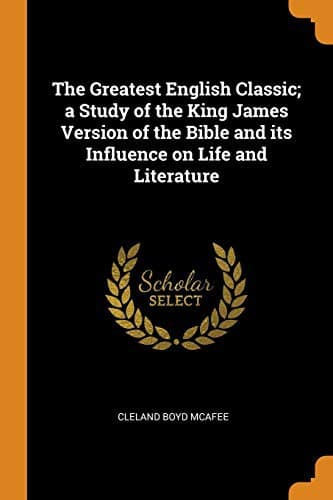
The Greatest English Classic: A Study of the King James Version of the Bible and Its Influence on Life and LiteratureMcAfee, Cleland Boyd
History
The Greatest English Classic: A Study of the King James Version of the Bible and Its Influence on Life and Literature
McAfee, Cleland Boyd
Bible -- History; Bible -- Influence; Bible and literature; Bible. English -- Versions -- Authorized
The danger is not simply with reference to the
great literature of the past. There is danger of
losing appreciation of the more delicate touches
of current literature, sometimes of a complete
missing of the meaning. An orator describing
present political and social conditions used a fine
phrase, that "it is time the nation camped for a
season at the foot of the mount." Only a knowledge
of Bible history will bring as a flash before
one the nation in the desert at Sinai learning
the meaning and power of law. Yet an intelligent
man, hearing that remark, said that
he counted it a fine figure, that he thought there
did come in the life of every nation a time before
it began its ascent to the heights when it
ought to pause and camp at the foot of the
mountain to get its breath! After Lincoln's
assassination Garfield stood on the steps in New
York, and said: "Clouds and darkness are around
about him! God reigns and the government at
Washington still lives!" Years after, some one
referring to that, said that it was a beautiful
sentence, that the reference to "clouds and
darkness" was a beautiful symbolism, but that
Garfield had a great knack in the building-up of
fine phrases! He lacked utterly the background
of the great Psalm which was in Garfield's mind,
and which gives that phrase double meaning.
If we go back to Tennyson again, some one has
proposed the inquiry why he should have called
one of his poems "Rizpah," since there was no
one of that name mentioned in the whole poem!
When, some years ago, a book was published,
The Children of Gideon, one of the reviewers
could not understand why that title was used,
since no one of that name appeared in the entire
volume. And when Mrs. Wharton's book, The
House of Mirth, came out some one spoke of the
irony of the title; but it is the irony of the Scriptures
and the book calls for a Scriptural knowledge
for its entire understanding.
Take even an encyclopedia article. Who can
understand these two sentences without instant
knowledge of Scripture? "Marlowe and Shakespeare,
the young Davids of the day, tried the
armor of Saul before they went out to battle,
then wisely laid it off." "Arnold, like Aaron
of old, stands between the dead and the living;
but, unlike Aaron, he holds no smoking censor of
propitiation to stay the plague which he feels
to be devouring his generation."[1] That is in an
encyclopedia to which young people are often
referred. What will they make out of it without
the Bible? In a widely distributed school
paper, in the question-and-answer department,
occurs the inquiry: "Who composed the inscription
on the Liberty Bell?" The inscription
is, "Proclaim liberty throughout all the land to
all the inhabitants thereof."[2] It is to be hoped
it was a very young person who needed to ask
who "composed" that expression!
[1] New International Encyclopedia, art. on English Literature.
[2] Current Events, January 12, 1912.
Public-domain text, read in full here on John Shaqi.
Reviews
Reviews
No reviews yet
Be the first to share your thoughts on this work.
Elsewhere in the archive
Join the Discussion
Join the discussion
Sign in to leave a comment or review.
Sign InorCreate an account