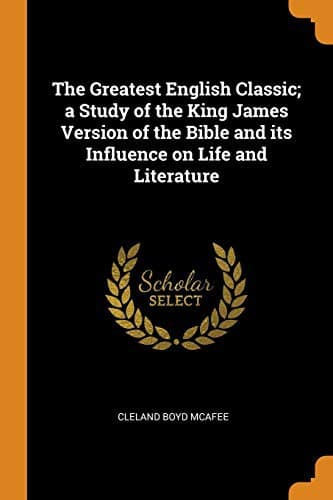
The Greatest English Classic: A Study of the King James Version of the Bible and Its Influence on Life and LiteratureMcAfee, Cleland Boyd
History
The Greatest English Classic: A Study of the King James Version of the Bible and Its Influence on Life and Literature
McAfee, Cleland Boyd
Bible -- History; Bible -- Influence; Bible and literature; Bible. English -- Versions -- Authorized
"made the English language," if Professor March
is right. The purpose of this study is to show
how that accident occurred, and what immediately
came from it.
With the death of Elizabeth the Tudor line
of sovereigns died out. The collateral Stuart
line, descending directly from Henry VII.,
naturally succeeded to the throne, and James
VI. of Scotland made his royal progress to the
English capital and became James I. of England.
In him appears the first of that Stuart
line during whose reign great changes were to
occur. Every one in the line held strongly to
the dogma of the divine right of kings, yet under
that line the English people transferred sovereignty
from the king to Parliament.[1] Fortunately
for history, and for the progress of popular
government, the Stuart line had no forceful
figures in it. Macaulay thinks it would have
been fatal to English liberty if they had been
able kings. It was easier to take so dangerous
a weapon as the divine right of kings from weak
hands than from strong ones. So it was that
though James came out of Scotland to assert
his divine and arbitrary right as sovereign, by
the time Queen Anne died, closing the Stuart
line and giving way to the Hanoverian, the real
sovereignty had passed into the hands of Parliament.
[1] Trevelyan, England Under the Stuarts.
But the royal traveler, coming from Edinburgh
to London, is interesting on his own
account--interesting at this distance. He is
thirty-seven years old, and ought to be in the
beginning of his prime. He is a little over
middle height; loves a good horse, though he is
an ungainly rider, and has fallen off his horse
three or four times during his royal progress;
is a heavy drinker of the liquors of the period,
with horribly coarse, even gross manners. Macaulay
is very severe with him. He says that
"his cowardice, his childishness, his pedantry,
his ungainly person and manners, his provincial
accent, made him an object of derision. Even
in his virtues and accomplishments there was
something eminently unkingly."[1] It seemed
too bad that "royalty should be exhibited to the
world stammering, slobbering, shedding unmanly
tears, trembling at the drawn sword, and
talking in the style alternately of a buffoon and
of a pedagogue." That is truly not an attractive
picture. But there is something on the
other side. John Richard Green puts both
sides: "His big head, his slobbering tongue, his
quilted clothes, his rickety legs stood out in as
grotesque a contrast with all that men recalled of
Henry and Elizabeth as his gabble and rhodomontade,
his want of personal dignity, his
buffoonery, his coarseness of speech, his pedantry,
his contemptible cowardice. Under this
ridiculous exterior, however, lay a man of much
natural ability, a ripe scholar with a considerable
fund of shrewdness, of mother wit and
ready repartee."[2]
[1] History of England, chap. i.
[2] Short History of the English People, chap. viii, sec. ii.
Public-domain text, read in full here on John Shaqi.
Reviews
Reviews
No reviews yet
Be the first to share your thoughts on this work.
Join the Discussion
Join the discussion
Sign in to leave a comment or review.
Sign InorCreate an account