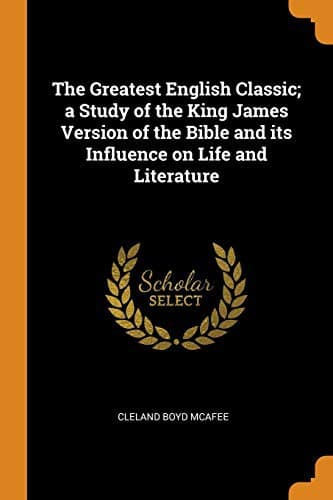
The Greatest English Classic: A Study of the King James Version of the Bible and Its Influence on Life and LiteratureMcAfee, Cleland Boyd
History
The Greatest English Classic: A Study of the King James Version of the Bible and Its Influence on Life and Literature
McAfee, Cleland Boyd
Bible -- History; Bible -- Influence; Bible and literature; Bible. English -- Versions -- Authorized
Very naturally the new King replied that he
would take it up later, and promised to call a
conference to consider it. And this he did.
The conference met at Hampton Court in January,
1604, and it was for this that the men
were coming from many parts of England. The
gathering was held on the 14th, 16th, and 18th
of the month. Its sole purpose was to consider
that Miliary Petition; but the King called to it
not only those who had signed the Petition, but
those who had opposed it. He had no notion
of granting any favor to it, and from the first
he gave the Puritans rough treatment. He
told them he would have none of their non-
conformity, he would "make them conform or
harry them out of the land." Someone suggested
that since this was a Church matter there be
called a Synod, or some general gathering fitted to
discuss and determine such things, rather than
leave it to a few Church dignitaries. For the
purposes of the petitioners it was a most unfortunate
expression. James had just come from
Scotland, where the Presbyterians were with
their Synod, and where Calvinism was in full
swing. He was much in favor of some elements
of Calvinism; but he could not see how all the
elements held together. Predestination, for
example, which offends so many people to-day,
was a precious doctrine to King James, and he
insisted that his subjects ought to see how clearly
God had predestined him to rule over them!
But he could not tolerate the necessary logical
inference of Calvinism that all men must be
equal before God, and so men can make and
unmake kings as they need to do so, the matter
of king or subject being purely an incidental
one. He remembered the time when Andrew
Melville, one of the Scotch ministers, had
plucked him by his royal sleeve and called him
"God's silly vassal" right to his face. So,
when some one said "Synod" it brought the
King up standing. He burst out: "If that is
what you mean, if you want what the Scotch
mean by their Synod and their Presbytery, then
I tell you at once that I will have none of it.
Presbytery agrees with monarchy very much as
God agrees with the devil. If you have no
bishop, you will soon have no king." He was
perfectly right, with reference to the kind of
king he meant. These things were to be settled,
he meant, by authority, and not by conference.
That is the point to which Gardiner
refers when he says that "in two minutes James
sealed his own fate and that of England forever."[1]
[1] History of England, 1603-42.
Public-domain text, read in full here on John Shaqi.
Reviews
Reviews
No reviews yet
Be the first to share your thoughts on this work.
Join the Discussion
Join the discussion
Sign in to leave a comment or review.
Sign InorCreate an account