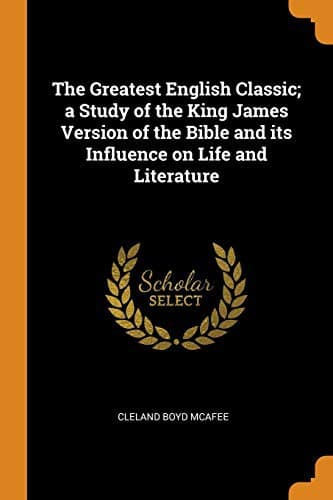
The Greatest English Classic: A Study of the King James Version of the Bible and Its Influence on Life and LiteratureMcAfee, Cleland Boyd
History
The Greatest English Classic: A Study of the King James Version of the Bible and Its Influence on Life and Literature
McAfee, Cleland Boyd
Bible -- History; Bible -- Influence; Bible and literature; Bible. English -- Versions -- Authorized
When they looked back on the conference,
the Puritans felt that they had lost everything,
and the High Church people that they had gained
everything. One of the bishops, in a very servile
way, and on his knee, gave thanks to God
for having given the country such a king, whose
like had never been seen since Christ was on
earth. Certainly hard times were ahead for
the Puritans. The King harried them according
to his word. Within sixteen years some of them
landed at Plymouth Rock, and things began to
happen on this side. That settlement at Plymouth
was the outcome of the threat the King
had made at the Hampton Court conference.
But looking back one can see that the conference
was worth while for the beginning of
the movement for the new version. The King
was true to his word in this line also, and before
the year was out had appointed the fifty-four
best Bible scholars of the realm to make the new
version. They were to sit in six companies of
nine each, two at Oxford, two at Cambridge,
and two at Westminster. The names of only
forty-seven of them have come down to us, and
it is not known whether the other seven were
ever appointed, or in what way their names have
been lost. It must be said for the King that the
only principle of selection was scholarship, and
when those six groups of men met they were
men of the very first rank, with no peers outside
their own numbers--with one exception, and
that exception is of some passing interest. Hugh
Broughton was probably the foremost Hebrew
scholar of England, perhaps of the world, at the
time, and apparently he was not appointed on
the committee. Chiefly, it seems to have been
because he was a man of ungovernable temper
and utterly unfitted to work with others. Failure
to appoint him, however, bit and rankled,
and the only keen and sharp criticism that was
passed on the version in its own day was by
Hugh Broughton. He sent word to the King,
after it was completed, that as for himself he
would rather be rent to pieces by wild horses
than have had any part in the urging of such a
wretched version of the Bible on the poor people.
That was so manifestly pique, however,
that it is only to be regretted that the translation
did not have the benefit of his great
Hebrew knowledge. John Selden, at his prime
in that day, voiced the feeling of most scholars
of the times, that the new translation was the
best in the world and best gave the sense of
the original.
Public-domain text, read in full here on John Shaqi.
Reviews
Reviews
No reviews yet
Be the first to share your thoughts on this work.
Join the Discussion
Join the discussion
Sign in to leave a comment or review.
Sign InorCreate an account