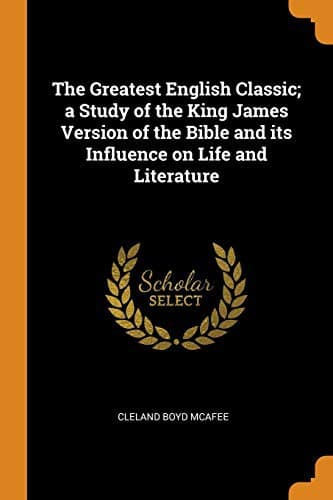
The Greatest English Classic: A Study of the King James Version of the Bible and Its Influence on Life and LiteratureMcAfee, Cleland Boyd
History
The Greatest English Classic: A Study of the King James Version of the Bible and Its Influence on Life and Literature
McAfee, Cleland Boyd
Bible -- History; Bible -- Influence; Bible and literature; Bible. English -- Versions -- Authorized
That is pure oratory, and it is greatly helped
by the English expression of it. Here our King
James version is finer than either of the other
later versions, as indeed it is in almost all these
sections where the phraseology is important for
the ear.
We need not go farther. Part of these outstanding
characteristics come to our version
from the original, and might appear in any version
of the Bible. Yet nowhere do even these
original characteristics come to such prominence
as in the King James translation; and it adds
to them those that are peculiar to itself.
LECTURE IV
THE INFLUENCE OF THE KING JAMES VERSION
ON ENGLISH LITERATURE
THE Bible is a book-making book. It is
literature which provokes literature.
It would be a pleasure to survey the whole
field of literature in the broadest sense and to
note the creative power of the King James version;
but that is manifestly impossible here.
Certain limitations must be frankly made.
Leave on one side, therefore; the immense body
of purely religious literature, sermons, expositions,
commentaries, which, of course, are the
direct product of the Bible. No book ever
caused so much discussion about itself and its
teaching. That is because it deals with the
fundamental human interest, religion. It still
remains true that the largest single department
of substantial books from our English presses is
in the realm of religion, and after the purely
recreative literature they are probably most
widely read. Yet, they are not what we mean
at this time by the literary result of the English
Bible.
Leave on one side also the very large body
of political and historical writing. Much of it
shows Bible influence. In the nature of the
case, any historian of the past three hundred
years must often refer to and quote from the
English Bible, and must note its influence. An
entire study could be devoted to the influence
of the English Bible on Green or Bancroft or
Freeman or Prescott--its influence on their
matter and their manner. Another could be
given to its influence on political writing and
speaking. No great orator of the day would fail
us of material, and the great political papers
and orations of the past would only widen the
field. Yet while some of this political and historical
writing is recognized as literature, most
of it can be left out of our thought just
now.
It may aid in the limiting of the field to
accept what Dean Stanley said in another connection:
"By literature, I mean those great
works that rise above professional or commonplace
uses and take possession of the mind of
a whole nation or a whole age."[1] This is one
of the matters which we all understand until
we begin to define it; we know what we mean
until some one asks us.
[1] Thoughts that Breathe.
Public-domain text, read in full here on John Shaqi.
Reviews
Reviews
No reviews yet
Be the first to share your thoughts on this work.
Elsewhere in the archive
Join the Discussion
Join the discussion
Sign in to leave a comment or review.
Sign InorCreate an account