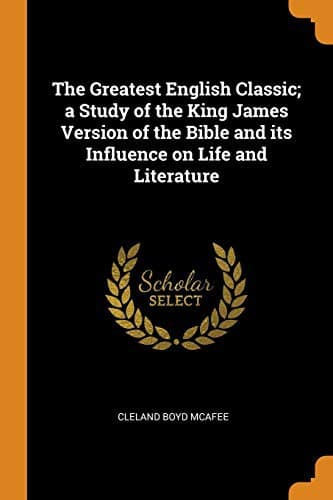
The Greatest English Classic: A Study of the King James Version of the Bible and Its Influence on Life and LiteratureMcAfee, Cleland Boyd
History
The Greatest English Classic: A Study of the King James Version of the Bible and Its Influence on Life and Literature
McAfee, Cleland Boyd
Bible -- History; Bible -- Influence; Bible and literature; Bible. English -- Versions -- Authorized
The literature of which we are thinking in this
narrower sense is in the sphere of art rather than
in the sphere of distinct achievement. De
Quincey's division is familiar: the literature of
knowledge, and the literature of power. The
function of the first is to teach; the function of
the second is to move. Professor Dowden
points out that between the two lies a third
field, the literature of criticism. It seeks both
to teach and to move. Our concern is chiefly
with De Quincey's second field--the literature
of power. In the first field, the literature of
knowledge, must lie all history, with Hume and
Gibbon; all science, with Darwin and Fiske;
all philosophy, with Spencer and William James;
all political writing, with Voltaire and Webster.
Near that same field must lie many of those
essays in criticism of which Professor Dowden
speaks. This which we omit, this literature of
knowledge, is powerful literature, though its
main purpose is not to move, but to teach.
We are only reducing our field so that we can
survey it. For our uses just now we shall
find pure literature taking the three standard
forms: the poem, the essay, and the story. It
is the influence of the English Bible on this
large field of literature which we are to observe.
Just for safety's sake, accept another narrowing
of the field. The effect of the Bible and its
religious teaching, on the writer himself is a
separate study, and is for the most part left out
of consideration. It sounds correct when Milton
says: "He who would not be frustrate of
his Power to write well ought himself to be a
true poem." But there is Milton himself to
deal with; irreproachable in morals, there are
yet the unhappy years of his young wife to
trouble us, and there were his daughters, who
were not at peace with him, and whom after
their service in his blindness he yet stigmatizes
in his will as "undutiful children." Then, if
you think of Shelley or Byron, you are troubled
by their lives; or even Carlyle, the very master
of the Victorian era--one would not like to scan
his life according to the laws of true poetry.
Then there is Coleridge, falling a prey to opium
until, as years came, conscience and will seemed
to go. Only a very ardent Scot will feel that he
can defend Robert Burns at all points, and we
would be strange Americans if we felt that
Edgar Allen Poe was a model of propriety. That
is a large and interesting field, but the Bible
seems even to gain power as a book-making book
when it lays hold on the book-making proclivities
of men who are not prepared to yield to its
personal power. They may get away from it
as religion; they do not get away from it as
literature.
Public-domain text, read in full here on John Shaqi.
Reviews
Reviews
No reviews yet
Be the first to share your thoughts on this work.
Elsewhere in the archive
Join the Discussion
Join the discussion
Sign in to leave a comment or review.
Sign InorCreate an account