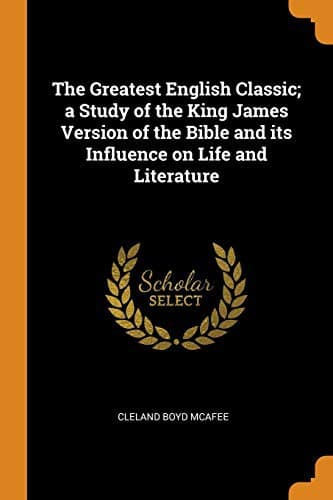
The Greatest English Classic: A Study of the King James Version of the Bible and Its Influence on Life and LiteratureMcAfee, Cleland Boyd
History
The Greatest English Classic: A Study of the King James Version of the Bible and Its Influence on Life and Literature
McAfee, Cleland Boyd
Bible -- History; Bible -- Influence; Bible and literature; Bible. English -- Versions -- Authorized
With that simple background let our minds
move down the course of literary history. Style,
language, material--we will easily think how
much of each the Bible has given to all our great
writers if their names are only mentioned. There
are four groups of these writers.
1. The Jacobean, who wrote when and just
after our version was made.
2. The Georgian, who graced the reigns of
the kings whose name the period bears.
3. The Victorian.
4. The American.
There is an attractive fifth group comprising
our present-day workers in the realm of pure
literature, but we must omit them and give our
attention to names that are starred.
It is familiar that in the time of Elizabeth,
"England became a nest of singing birds." In
the fifty years after the first English theater was
erected, the middle of Elizabeth's reign, fifty
dramatic poets appeared, many of the first
order. Some were distinctly irreligious, as were
many of the people whose lives they touched.
Such men as Ford, Marlowe, Massinger, Webster,
Beaumont, and Fletcher stand like a chorus
around Shakespeare and Ben Jonson as leaders.
As Taine puts it: "They sing the same piece
together, and at times the chorus is equal to the
solo; but only at times."[1] Cultured people
to-day know the names of most of these writers,
but not much else, and it does not heavily serve
our argument to say that they felt the Puritan
influence; but they all did feel it either directly
or by reaction.
[1] History of English Literature, chap. iii.
Edmund Spenser and his friend, Sir Philip
Sidney, had closed their work before the King
James version appeared, yet the Faerie Queene
in its religious theory is Puritan to the core,
and Sidney is best remembered by his paraphrases
of Scripture. The influence of both
was even greater in the Jacobean than in their
own period.
Public-domain text, read in full here on John Shaqi.
Reviews
Reviews
No reviews yet
Be the first to share your thoughts on this work.
Elsewhere in the archive
Join the Discussion
Join the discussion
Sign in to leave a comment or review.
Sign InorCreate an account