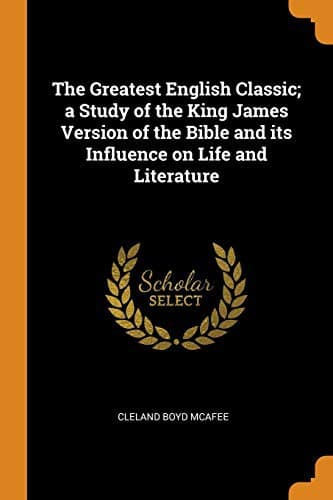
The Greatest English Classic: A Study of the King James Version of the Bible and Its Influence on Life and LiteratureMcAfee, Cleland Boyd
History
The Greatest English Classic: A Study of the King James Version of the Bible and Its Influence on Life and Literature
McAfee, Cleland Boyd
Bible -- History; Bible -- Influence; Bible and literature; Bible. English -- Versions -- Authorized
The second element which English literature
finds in the Bible is its LANGUAGE. The words of
the Bible are the familiar ones of the English
tongue, and have been kept familiar by the use
of the Bible. The result is that "the path of
literature lies parallel to that of religion. They
are old and dear companions, brethren indeed
of one blood; not always agreeing, to be sure;
squabbling rather in true brotherly fashion now
and then; occasionally falling out very seriously
and bitterly; but still interdependent and necessary
to each other."[1] Years ago a writer remarked
that every student of English literature,
or of English speech, finds three works or subjects
referred to, or quoted from, more frequently
than others. These are the Bible, tales of Greek
and Roman mythology, and Aesop's Fables. Of
these three, certainly the Bible furnishes the
largest number of references. There is reason
for that. A writer wants an audience. Very
few men can claim to be independent of the
public for which they write. There is nothing
the public will be more apt to understand and
appreciate quickly than a passing reference to
the English Bible. So it comes about that when
Dickens is describing the injustice of the Murdstones
to little David Copperfield, he can put
the whole matter before us in a parenthesis:
"Though there was One once who set a child
in the midst of the disciples." Dickens knew
that his readers would at once catch the meaning
of that reference, and would feel the contrast
between the scene he was describing and that
simple scene. Take any of the great books of
literature and black out the phrases which manifestly
come directly from the English Bible, and
you would mark them beyond recovery.
[1] Chapman, English Literature in Account with Religion.
But English literature has found more of its
material in the Bible than anything else. It has
looked there for its characters, its illustrations,
its subject-matter. We shall see, as we consider
individual writers, how many of their titles and
complete works are suggested by the Bible.
It is interesting to see how one idea of the
Scripture will appear and reappear among many
writers. Take one illustration. The Faust story
is an effort to make concrete one verse of Scripture:
"What shall it profit a man if he shall
gain the whole world and lose his own soul?"
Professor Moulton reminds us that the Faust
legend appeared first in the Middle Ages. In
early English, Marlowe has it, Calderon put it
into Spanish, the most familiar form of it is
Goethe's, while Philip Bailey has called his
account of it Festus. In each of those forms
the same idea occurs. A man sells his soul to
the devil for the gaining of what is to him the
world. That is one of a good many ideas which
the Bible has given to literature. The prodigal
son has been another prolific source of literary
writing. The guiding star is another. Others
will readily come to mind.
Public-domain text, read in full here on John Shaqi.
Reviews
Reviews
No reviews yet
Be the first to share your thoughts on this work.
Elsewhere in the archive
Join the Discussion
Join the discussion
Sign in to leave a comment or review.
Sign InorCreate an account