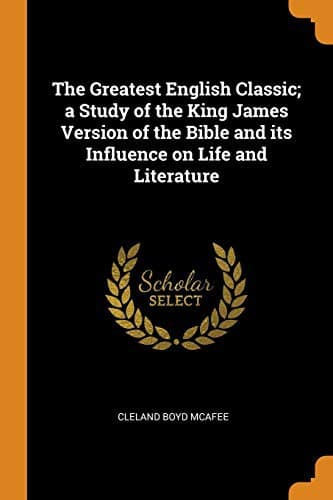
The Greatest English Classic: A Study of the King James Version of the Bible and Its Influence on Life and LiteratureMcAfee, Cleland Boyd
History
The Greatest English Classic: A Study of the King James Version of the Bible and Its Influence on Life and Literature
McAfee, Cleland Boyd
Bible -- History; Bible -- Influence; Bible and literature; Bible. English -- Versions -- Authorized
But after these poems came the period of his
prose, the work which he supposed was the abiding
work of his life. George William Curtis told
a friend that our civil war changed his own
literary style: "That roused me to see that I
had no right to spend my life in literary leisure.
I felt that I must throw myself into the struggle
for freedom and the Union. I began to lecture
and to write. The style took care of itself.
But I fancy it is more solid than it was thirty
years ago." That is what happened to Milton
when the protectorate came.[1] It made his style
more solid. He did not mean to live as a poet.
He felt that his best energies were being put into
his essays in defense of liberty, on the freedom
of the press and on the justice of the beheading
of Charles, in which service he sacrificed his
sight. All of it is shot through with Scripture
quotations and arguments, and some of it, at
least, is in the very spirit of Scripture. The plea
for larger freedom of divorce issued plainly from
his own bitter experience; but his main argument
roots in a few Bible texts taken out of
their connection and urged with no shadow of
question of their authority. Indeed, when he
comes to his more religious essays, his heavy
argument is that there should be no religion
permitted in England which is not drawn directly
from the Bible; which, therefore, he urges
must be common property for all the people.
There is a curious bit of evidence that the men
of his own time did not realize his power as a
poet. In Pierre Bayle's critical survey of the
literature of the time, he calls Milton "the
famous apologist for the execution of Charles
I.," who "meddled in poetry and several of whose
poems saw the light during his life or after his
death!" For all that, Milton was only working
on toward his real power, and his power was to
be shown in his service to religion. His three
great poems, in the order of their value, are, of
course, "Paradise Lost," "Samson Agonistes,"
and "Paradise Regained." Whoever knows anything
of Milton knows these three and knows
they are Scriptural from first to last in phrase,
in allusion, and, in part at least, in idea. There
is not time for extended illustration. One instance
may stand for all, which shall illustrate
how Milton's mind was like a garden where the
seeds of Scripture came to flower and fruit. He
will take one phrase from the Bible and let it
grow to a page in "Paradise Lost." Here is an
illustration which comes readily to hand. In
the Genesis it is said that "the spirit of God
moved on the face of the waters." The verb
suggests the idea of brooding. There is only
one other possible reference (Psalm xxiv: 9.)
which is included in this statement which Milton
makes out of that brief word in the Genesis:
Public-domain text, read in full here on John Shaqi.
Reviews
Reviews
No reviews yet
Be the first to share your thoughts on this work.
Elsewhere in the archive
Join the Discussion
Join the discussion
Sign in to leave a comment or review.
Sign InorCreate an account