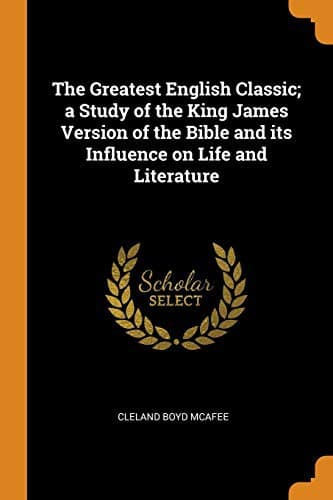
The Greatest English Classic: A Study of the King James Version of the Bible and Its Influence on Life and LiteratureMcAfee, Cleland Boyd
History
The Greatest English Classic: A Study of the King James Version of the Bible and Its Influence on Life and Literature
McAfee, Cleland Boyd
Bible -- History; Bible -- Influence; Bible and literature; Bible. English -- Versions -- Authorized
"On the watery calm
His broadening wings the Spirit of God outspread,
And vital virtue infused, and vital warmth
Throughout the fluid mass, but downward purged
The black tartareous cold infernal dregs,
Adverse to life; then formed, then con-globed,
Like things to like; the rest to several place
Disparted, and between spun out the air--
And earth self-balanced on her center swung."
[1] Strong, The Theology of the Poets.
Any one familiar with Milton will recognize
that as a typical instance of the way in which
a seed idea from the Scripture comes to flower
and fruit in him. The result is that more people
have their ideas about heaven and hell from
Milton than from the Bible, though they do not
know it.
It seems hardly fair to use John Bunyan
(1628-1688) as an illustration of the influence
of the English Bible on literature, because his
chief work is composed so largely in the language
of Scripture. Pilgrim's Progress is the most
widely read book in the English language after
the Bible. Its phrases, its names, its matter
are either directly or indirectly taken from the
Bible. It has given us a long list of phrases
which are part of our literary and religious
capital. Thackeray took the motto of one of
his best-known books from the Bible; but the
title, Vanity Fair, comes from Pilgrim's Progress.
When a discouraged man says he is "in the
slough of despond," he quotes Bunyan; and
when a popular evangelist tells the people that
the burden of sin will roll away if they look at
the cross, "according to the Bible," he ought
to say according to Bunyan. But all this was
only the outcome of the familiarity of Bunyan
with the Scripture. It was almost all he did
know in a literary way. Macaulay says that
"he knew no language but the English as it
was spoken by the common people; he had
studied no great model of composition, with the
exception of our noble translation of the Bible.
But of that his knowledge was such that he might
have been called a living concordance."[1]
[1] History of England, vol. III., p. 220.
Public-domain text, read in full here on John Shaqi.
Reviews
Reviews
No reviews yet
Be the first to share your thoughts on this work.
Elsewhere in the archive
Join the Discussion
Join the discussion
Sign in to leave a comment or review.
Sign InorCreate an account