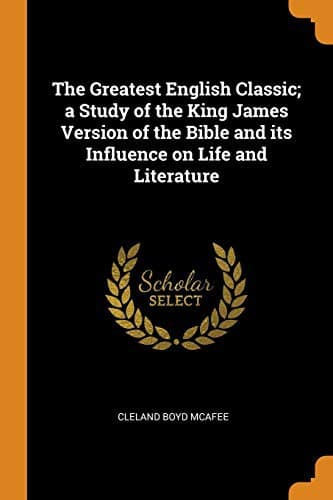
The Greatest English Classic: A Study of the King James Version of the Bible and Its Influence on Life and LiteratureMcAfee, Cleland Boyd
History
The Greatest English Classic: A Study of the King James Version of the Bible and Its Influence on Life and Literature
McAfee, Cleland Boyd
Bible -- History; Bible -- Influence; Bible and literature; Bible. English -- Versions -- Authorized
The very mention of Coleridge makes one
think of Wordsworth. They had a Damon and
Pythias friendship. The Wordsworths were
poor; they had only seventy pounds a year, and
they were not ashamed. Coleridge called them
the happiest family he ever saw. Wordsworth
was not narrowly a Christian poet, he was not
always seeking to put Christian dogma into
poetry, but throughout he was expressing the
Christian spirit which he had learned from the
Bible. His poetry was one long protest against
banishing God from the universe. It was literally
true of him that "the meanest flower that
grows can give thoughts that too often lie too deep
for tears." If this were the time to be critical,
one would think that too much was sometimes
made of very minute occurrences; but this
tendency to get back of the event and see how
God is moving is learned best from Scripture,
where Wordsworth himself learned it. If you
read his "Intimations of Immortality," or the
"Ode to Duty," or "Tintern Abbay," or even
the rather labored "Excursion," you find yourself
under the Scriptural influence.
There remains in this Georgian group the
great prose master, Walter Scott. Mr. Gladstone
said he thought Scott the greatest of his
countrymen. John Morley suggested John Knox
instead. Mr. Gladstone replied: "No, the line
must be drawn firmly between the writer and
the man of action--no comparison there."[1] He
went on to say that Burns is very fine and true,
no doubt, "but to imagine a whole group of
characters, to marshal them, to set them to
work, and to sustain the action, I must count
that the test of highest and most diversified
quality." All who are fond of Scott will realize
how constantly the scenes which he is describing
group themselves around religious observances,
how often men are held in check from deeds of
violence by religious conception. Many of these
scenes crystallize around a Scriptural event.
Scott's boyhood was spent in scenes that
reminded him of the power the Scripture had.
He was drilled from his childhood in the knowledge
of its words and phrases, and while his
writing as a whole shows more of the Old Testament
influence than of the New, even in his style
he is strongly under Bible influence.
[1] Morley, Life of Gladstone, vol. iii, p. 424.
Public-domain text, read in full here on John Shaqi.
Reviews
Reviews
No reviews yet
Be the first to share your thoughts on this work.
Elsewhere in the archive
Join the Discussion
Join the discussion
Sign in to leave a comment or review.
Sign InorCreate an account