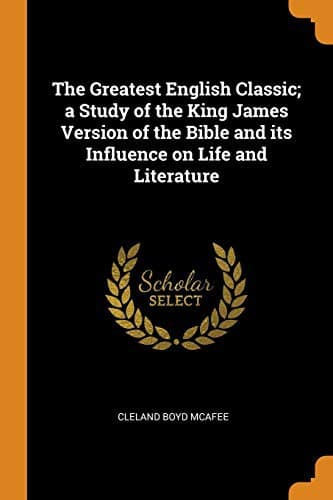
The Greatest English Classic: A Study of the King James Version of the Bible and Its Influence on Life and LiteratureMcAfee, Cleland Boyd
History
The Greatest English Classic: A Study of the King James Version of the Bible and Its Influence on Life and Literature
McAfee, Cleland Boyd
Bible -- History; Bible -- Influence; Bible and literature; Bible. English -- Versions -- Authorized
The preface to Guy Mannering tells us it is
built around an old story of a father putting a
lad to test under guidance of an ancient astrologer,
shutting him up in a barren room to be
tempted by the Evil One, leaving him only one
safeguard, a Bible, lying on the table in the
middle of the room. In his introduction to
The Heart of Midlothian, Scott makes one of the
two men thrown into the water by the overturned
coach remind the other that they "cannot
complain, like Cowley, that Gideon's fleece
remains dry while all around is moist; this is
the reverse of the miracle." A little later a
speaker describes novels as the Delilahs that
seduce wise and good men from more serious
reading. In the dramatic scene when Jeanie
Deans faces the wretched George Staunton, who
has so shamed the household, she exclaims:
"O sir, did the Scripture never come into your
mind, 'Vengeance is mine, and I will repay
it?' " "Scripture!" he sneers, "why I had not
opened a Bible for five years." "Wae's me,
sir," said Jeanie--"and a minister's son, too!"
Anthony Foster, in Kenilworth, looks down on
poor Amy's body in the vault into which she
has fallen, in response to what she thought was
Leicester's whistle, and exclaims to Varney:
"Oh, if there be judgment in heaven, thou hast
deserved it, and will meet it! Thou hast destroyed
her by means of her best affections--it
is the seething of the kid in the mother's milk!"
And when, next morning, Varney was found
dead of the secret poison and with a sneering
sarcasm on his ghastly face, Scott dismisses him
with the phrase: "The wicked man, saith the
Scripture, hath no bonds in his death."
His characters use freely the familiar Bible
events and phrases. In the Fortunes of Nigel, a
story of the very period when our King James
version was produced, Hildebrod declares that
if he had his way Captain Peppercull should
hang as high as Haman ever did. In Kenilworth,
when Leicester gives Varney his signet-
ring, he says, significantly: "What thou dost,
do quickly." Of course, Isaac, the Jew in Ivanhoe,
exclaims frequently in Old Testament terms.
He wishes the wheels of the chariots of his
enemies may be taken off, like those of the host
of Pharoah, that they may drive heavily. He
expects the Palmer's lance to be as powerful as
the rod of Moses, and so on.
Scott was writing of the period when men
stayed themselves with Scripture, and his men
are all sure of God and Satan and angels and
judgment and all eternal things. His son-in-
law vouches for the old story that when Sir
Walter was on his death-bed he asked Lockhart
to read him something from the Book, and
when Lockhart asked, "What book?" Scott replied:
"Why do you ask? There is but one
book, the Bible."
All this is scant justice to the Georgian group;
but it may give a hint of what the Bible meant
even at that period, the period when its grip
on men was most lax in all the later English
history.
Public-domain text, read in full here on John Shaqi.
Reviews
Reviews
No reviews yet
Be the first to share your thoughts on this work.
Elsewhere in the archive
Join the Discussion
Join the discussion
Sign in to leave a comment or review.
Sign InorCreate an account