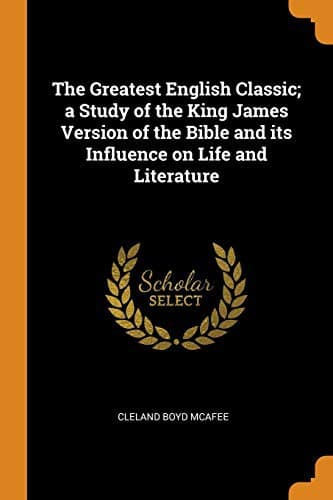
The Greatest English Classic: A Study of the King James Version of the Bible and Its Influence on Life and LiteratureMcAfee, Cleland Boyd
History
The Greatest English Classic: A Study of the King James Version of the Bible and Its Influence on Life and Literature
McAfee, Cleland Boyd
Bible -- History; Bible -- Influence; Bible and literature; Bible. English -- Versions -- Authorized
It is in the Victorian age (1840-1900) that the
field is most bewildering. It is true, as Frederick
Harrison says, that "this Victorian age has no
Shakespeare or Milton, no Bacon or Hume, no
Fielding or Scott--no supreme master in poetry,
philosophy, or romance whose work is incorporated
with the thought of the world, who is
destined to form an epoch, to endure for
centuries."[1] The genius of the period is more
scientific than literary, yet we would be helpless
if we had not already eliminated from our discussion
everything but the works and writers
of pure literature. The output of books has been
so tremendous that it would be impossible to
analyze the influences which have made them.
There are in this Victorian period at least twelve
great English writers who must be known, whose
work affects the current of English literature.
Many other names would need mention in any
full history or any minute study; but it is not
harsh judgment to say that the main current
of literature would be the same without them.
A few of these lesser names will come to mind,
and in the calling of them one realizes the
influence, even on them, of the English Bible.
Anthony Trollope wrote sixty volumes, the titles
of most of which are now popularly unknown.
He told George Eliot that it was not brains that
explained his writing so much, but rather wax
which he put in the seat of his chair, which held
him down to his daily stint of work. He could
boast, and it was worth the boasting, that he
had never written a line which a pure woman
could not read without a blush. His whole
Framley Parsonage series abounds in Bible
references and allusions. So Charlotte Bronte is
in English literature, and Jane Eyre does prove
what she was meant to prove, that a commonplace
person can be made the heroine of a novel;
but on all Charlotte Bronte's work is the mark
of the rectory in which she grew up. So Thomas
Grey has left his "Elegy" and his "Hymn to
Adversity," and some other writing which most of
us have forgotten or never knew. Then there
are Maria Edgeworth and Jane Austen. We
may even remember that Macaulay thought
Jane Austen could be compared with Shakespeare,
as, of course, she can be, since any one
can be; but neither of these good women has
strongly affected the literary current. Many
others could be named, but English literature
would be substantially the same without them;
and, though all might show Biblical influence,
they would not illustrate what we are trying to
discover. So we come, without apology to the
unnamed, to the twelve, without whom English
literature would be different. This is the list
in the order of the alphabet: Matthew Arnold,
Robert Browning (Mrs. Browning being grouped
as one with him), Carlyle, Dickens, George Eliot,
Charles Kingsley, Macaulay, Ruskin, Robert
Louis Stevenson, Swinburne, Tennyson, and
Thackeray.
[1] Early Victorian Literature, p. 9
Public-domain text, read in full here on John Shaqi.
Reviews
Reviews
No reviews yet
Be the first to share your thoughts on this work.
Elsewhere in the archive
Join the Discussion
Join the discussion
Sign in to leave a comment or review.
Sign InorCreate an account