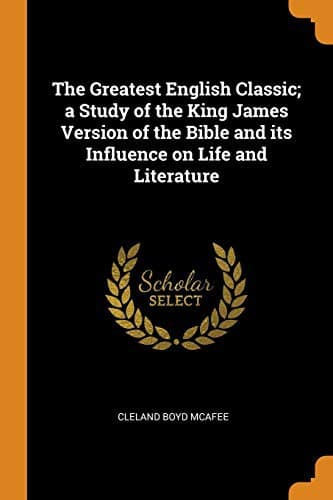
The Greatest English Classic: A Study of the King James Version of the Bible and Its Influence on Life and LiteratureMcAfee, Cleland Boyd
History
The Greatest English Classic: A Study of the King James Version of the Bible and Its Influence on Life and Literature
McAfee, Cleland Boyd
Bible -- History; Bible -- Influence; Bible and literature; Bible. English -- Versions -- Authorized
We need spend little time in discussing the
influence of the English Bible on Thomas Carlyle.
He does not often use the Scripture for
his main theme; but he is constantly making
Biblical allusions. On a railway journey when
I was rereading Carlyle's Historical Sketches, I
found a direct Biblical reference for every five
pages, and almost numberless allusions beside.
The "Everlasting Yea," of which he says
much, he gets, as you at once recognize, from
the Scripture. His "Heroes and Hero Worship"
is based on an idea of heroism which he learned
from the Bible. He is an Old Testament prophet
of present times; and, while he degenerated
into a scold before he was through with it, he
yet spoke with the thunderous voice of a true
prophet, and much of the time in the language
of the prophets. Some one said once that the
only real reverence Carlyle ever had was for
the person of Christ. Certainly there is no note
of sneer, but of the profoundest regard for the
teaching, the ideas and the history of the Scripture.
The name of Charles Dickens suggests a
different atmosphere. He is a New Testament
prophet. Where Carlyle has caught the spirit
of rugged power in the Old Testament, Dickens
has caught the sense of kindly love in the New
Testament. Dickens's love for the child, the
fact that he could draw children as he could draw
no one else and make them lovable, suggests the
value to him of those frequent references which
he makes to Christ setting a child in the midst
of the disciples. It is notable, too, how often
Dickens uses the great Scripture phrases for his
most dramatic climaxes. There are not in literature
many finer uses of Scripture than the scene
in Bleak House, where the poor waif Joe is dying,
and while his friend teaches him the Lord's
Prayer he sees the light coming. A Christmas
season without Dickens's Christmas Carol would
be incomplete; but there again is the Scripture
idea pressed forward.
George Eliot surely, if any writer, was under
the spell of the Scripture. One of her critics
calls her the historian of conscience. All of her
heroes and heroines know the lash of the law.
She knows very little about the New Testament,
one would judge; but the one thing about which
she has no doubt is certainly the reign of moral
law. If a man will not yield to its power, it will
break him. There is no such thing as breaking
the moral law; there is nothing but being broken
by it. Her characters are always quoting the
Bible. They preach a great deal. She tells
that she herself wrote Dinah Morris's sermon on
the green with tears in her eyes. She meant it
all. While her own religious faith was clouded,
her finest characters are never clouded in their
religious faith, and she grounds their faith quite
invariably on their early training in the Scripture.
It is an interesting fact that George Eliot
has no principal story which has not in it a
church, and a priest or a preacher, with all that
they involve.
Public-domain text, read in full here on John Shaqi.
Reviews
Reviews
No reviews yet
Be the first to share your thoughts on this work.
Elsewhere in the archive
Join the Discussion
Join the discussion
Sign in to leave a comment or review.
Sign InorCreate an account