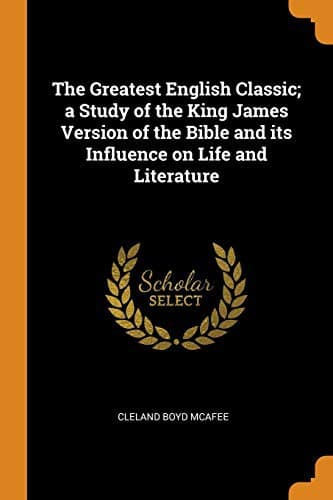
The Greatest English Classic: A Study of the King James Version of the Bible and Its Influence on Life and LiteratureMcAfee, Cleland Boyd
History
The Greatest English Classic: A Study of the King James Version of the Bible and Its Influence on Life and Literature
McAfee, Cleland Boyd
Bible -- History; Bible -- Influence; Bible and literature; Bible. English -- Versions -- Authorized
Charles Kingsley is grouped hardly fairly in
this list, because he was himself a preacher, and
naturally all his work would feel the power of
the Book, which he chiefly studied. Professor
Masson says that "there is not one of his novels
which has not the power of Christianity for its
theme." No voice was raised more effectively
for the beginning of the new social era in England
than his. Alton Locke and Yeast are epoch-
making books in the life of the common people
of England. Even Hypatia, which is supposed
to have been written to represent entirely pagan
surroundings, is full of Bible phrases and
ideas.
Lord Macaulay had been held up for many a
day as one of the masters of style. Such great
writing is not to be traced to any one influence.
It could not have been easy to write as Macaulay
wrote. Thackeray may have exaggerated
in saying that Macaulay read twenty books to
write a sentence, and traveled a hundred miles
to make a description; but all his writing shows
the power of taking infinite pains. It becomes
the more important, therefore, that Macaulay
held the Bible in such estimate as he did. "In
calling upon Lady Holland one day, Lord
Macaulay was led to bring the attention of his
fair hostess to the fact that the use of the word
'talent' to mean gifts or powers of the mind,
as when we speak of men of talent, came from
the use of the word in Christ's parable of the
talents. In a letter to his sister Hannah he describes
the incident, and says that Lady Holland
was evidently ignorant of the parable. 'I
did not tell her,' he adds, 'though I might have
done so, that a person who professes to be a
critic in the delicacies of the English language
ought to have the Bible at his fingers' ends.' "
That Macaulay practised his own preaching you
would quickly find by referring to his essays.
Take three sentences from the Essay on Milton:
"The principles of liberty were the scoff of every
growing courtier, and the Anathema Maranatha
of every fawning dean. In every high place
worship was paid to Charles and James, Belial
and Moloch, and England propitiated these obscene
and cruel idols with the blood of her best
and brightest children. Crime succeeded to
crime, and disgrace to disgrace, until the race,
accursed of God and man, was a second time
driven forth to wander on the face of the earth
and to be a by-word and a shaking of the head
to the nations." In three sentences here are
six allusions to Scripture. In that same essay,
in the paragraphs on the Puritans, the allusions
are a multitude. They are not even quoted.
They are taken for granted. In his Essay on
Machiavelli, though the subject does not suggest
it, he falls into Scriptural phrases over and
over. Listen to this, "A time was at hand when
all the seven vials of the Apocalypse were to be
poured forth and shaken out over those pleasant
countries"; or this, "All the curses pronounced
of old against Tyre seemed to have
fallen on Venice. Her merchants already stood
Public-domain text, read in full here on John Shaqi.
Reviews
Reviews
No reviews yet
Be the first to share your thoughts on this work.
Elsewhere in the archive
Join the Discussion
Join the discussion
Sign in to leave a comment or review.
Sign InorCreate an account