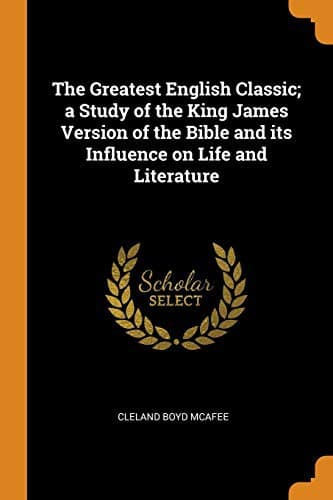
The Greatest English Classic: A Study of the King James Version of the Bible and Its Influence on Life and LiteratureMcAfee, Cleland Boyd
History
The Greatest English Classic: A Study of the King James Version of the Bible and Its Influence on Life and Literature
McAfee, Cleland Boyd
Bible -- History; Bible -- Influence; Bible and literature; Bible. English -- Versions -- Authorized
Not only was Ruskin well trained in the Bible,
but he was a great teacher of it. In his preface
to the Crown of Wild Olives he answers his critics
by saying he has used the Book for some forty
years. "My endeavor has been uniformly to
make men read it more deeply than they do;
trust it, not in their own favorite verses only,
but in the sum of it all; treat it not as a fetish
or a talisman which they are to be saved by daily
repetition of, but as a Captain's order, to be held
and obeyed at their peril." In the introduction
to the Seven Lamps of Architecture he urges that
we are in no danger of too much use of the Bible.
"We use it most reverently when most habitually."
Many of Ruskin's most striking titles
come straight out of the Scripture. Crown of
Wild Olives, Seven Lamps, Unto this Last--all
these are suggested by the Bible.
It is almost superfluous to speak of Robert
Louis Stevenson. John Kelman has written a
whole book on the religion of Stevenson, and it
is available for all readers. He was raised by
Cummy, his nurse, whose library was chiefly the
Bible, the shorter catechism, and the Life of
Robert Murray McCheyne. He said that the
fifty-eighth chapter of Isaiah was his special
chapter, because it so repudiated cant and demanded
a self-denying beneficence. He loved
Bunyan's Pilgrim's Progress; but "the Bible
most stood him in hand." Every great story
or essay shows its influence. He was not critical
with it; he did not understand it; he did not
interpret it fairly; but he felt it. His Dr. Jekyll
and Mr. Hyde is only his way of putting into
modern speech Paul's old distinction between
the two men who abide in each of us. They
told him he ought not to work in Samoa, and he
replied that he could not otherwise be true to
the great Book by which he and all men who
meant to do great work must live. Over the
shoulder of our beloved Robert Louis Stevenson
you can see the great characters of Scripture
pressing him forward to his best work.
Public-domain text, read in full here on John Shaqi.
Reviews
Reviews
No reviews yet
Be the first to share your thoughts on this work.
Elsewhere in the archive
Join the Discussion
Join the discussion
Sign in to leave a comment or review.
Sign InorCreate an account