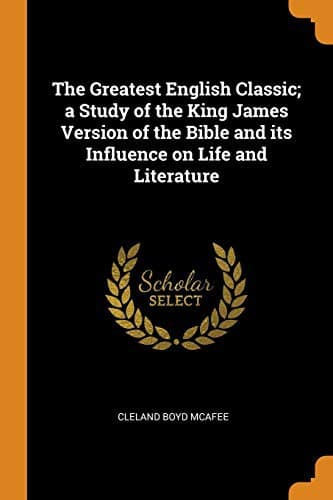
The Greatest English Classic: A Study of the King James Version of the Bible and Its Influence on Life and LiteratureMcAfee, Cleland Boyd
History
The Greatest English Classic: A Study of the King James Version of the Bible and Its Influence on Life and Literature
McAfee, Cleland Boyd
Bible -- History; Bible -- Influence; Bible and literature; Bible. English -- Versions -- Authorized
afar off lamenting for their great city"; or this,
"In the energetic language of the prophet,
Machiavelli was mad for the sight of his eyes
which he saw."
And if Macaulay is baffling in the abundance
of material, surely John Ruskin is worse. Carlyle's
English style ran into excess of roughness;
Macaulay's ran into excess of balance and delicacy.
John Ruskin's continued to be the smoothest,
easiest style in our English literature. He
also was a Hebraic spirit, but of the gentler type.
Mr. Chapman calls him the Elisha to Carlyle's,
Elijah, a capital comparison.[1] Ruskin is one of
the few writers who have told us what formed
their style. In the first chapter of Praeterita he
pays tribute to his mother. He himself chose
to read Walter Scott and Pope's Homer; but he
says: "My mother forced me by steady daily
toil to learn long chapters of the Bible by heart,
as well as to read it, every syllable aloud, hard
names and all, from Genesis to the Apocalypse
about once a year; and to that discipline--
patient, accurate, and resolute--I owe not only
a knowledge of the Book which I find occasionally
serviceable, but much of my general power
of taking pains and the best part of my taste
in literature." He thinks reading Scott might
have led to other novels of a poorer sort.
Reading Pope might have led to Johnson's
or Gibbon's English; but "it was impossible
to write entirely superficial and formal English"
while he knew "by heart the thirty-
second of Deuteronomy, the fifteenth of I
Corinthians, the One hundred and nineteenth
Psalm, or the Sermon on the Mount." In the
second chapter of Praeterita he is even more
explicit. "I have next with deeper gratitude to
chronicle what I owed to my mother for the resolute
persistent lessons which so exercised me in
the Scripture, as to make every word of them
familiar in my ear as habitual music, yet in that
familiarity reverenced as transcending all thought
and ordering all conduct." He tells how his
mother drilled him. As soon as he could read
she began a course of Bible work with him.
They read alternate verses from the Genesis to
the Revelation, names and all. Daily he had to
commit verses of the Scripture. He hated the
One hundred and nineteenth Psalm most; but
he lived to cherish it most. In his old Bible he
found the list of twenty-six chapters taught by
his mother.
[1] English Literature in Account with Religion.
Public-domain text, read in full here on John Shaqi.
Reviews
Reviews
No reviews yet
Be the first to share your thoughts on this work.
Elsewhere in the archive
Join the Discussion
Join the discussion
Sign in to leave a comment or review.
Sign InorCreate an account