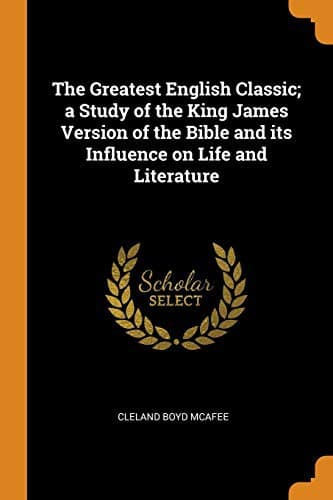
The Greatest English Classic: A Study of the King James Version of the Bible and Its Influence on Life and LiteratureMcAfee, Cleland Boyd
History
The Greatest English Classic: A Study of the King James Version of the Bible and Its Influence on Life and Literature
McAfee, Cleland Boyd
Bible -- History; Bible -- Influence; Bible and literature; Bible. English -- Versions -- Authorized
That makes only twelve names from Franklin
to Whittier. Others could be included; but
they are not so great as these. No one of these
could be taken out of our literature without
affecting it and, in some degree at least, changing
the current of it. This is not to forget
Bret Harte nor Samuel L. Clemens. But each
is dependent for his survival on a taste for a
certain kind of humor, not delicate like Irving's
and Holmes's, but strong and sudden and a bit
sharp. If we should forget the "Luck of Roaring
Camp," "Truthful James," and the "Heathen
Chinee," we would also forget Bret Harte. We
are not apt to forget Tom Sawyer, nor perhaps
The Innocents Abroad, but we are forgetting much
else of Mark Twain. Whitman is not named.
His claims are familiar, but in spite of his admirers
he seems so charged with a sensuous egotism
that he is not apt to be a formative influence in
literary history. It is still interesting, however,
to remember how frequently he reveals his reading
of Scripture.
Fortunately, all these writers are so near, and
their work is so familiar, that details regarding
them are not needed. Two or three general
words can be said. In the first place, observe
the high moral tone of all these first-grade
writers, and, indeed, of the others who may be
spoken of as in second rank. There is not a
meretricious or humiliating book in the whole
collection. There is not one book which has
lived in American literature which has the tone
of Fielding's Tom Jones. Whether it is that the
Puritan strain continues in us or not, it is true
that the American literary public has not taken
happily to stories that would bring a blush in
public reading. Professor Richardson, of Dartmouth,
gives some clue to the reason of that.
He says that "since 1870 or 1880 in America
there has been a marked increase of strength
of theistic and spiritual belief and argument
among scientific men, students of philosophy,
religious 'radicals,' and others." He adds that
while much contemporary American literature
and thought is outside the accepted orthodox
lines, yet "it is not hostile to Christianity; to
the principles of its Founder it is for the most
part sincerely attached. On the other hand,
materialism has scarcely any hold upon it."
Then follows a very notable sentence which is
sustained by the facts: "Not an American book
of the first class has ever been written by an
atheist or denier of immortality." That sentence
need not offend an admirer of Walt Whitman,
for he "accepts both theism and the doctrine
of the future life." American thought has
remained loyal to the great Trinity, God, Freedom,
and Immortality. So it comes about that
while there are a number of these writers who
could be put under the ban of the strongly
orthodox in religion, every one of them shows
the effect of early training in religion and in
the Scripture.[1]
[1] This is fully worked out in Professor Richardson's American
Literature, with ample illustration and argument.
Public-domain text, read in full here on John Shaqi.
Reviews
Reviews
No reviews yet
Be the first to share your thoughts on this work.
Elsewhere in the archive
Join the Discussion
Join the discussion
Sign in to leave a comment or review.
Sign InorCreate an account