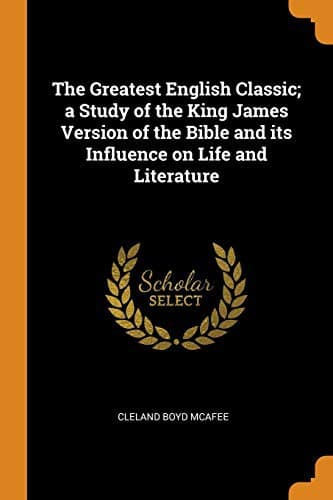
The Greatest English Classic: A Study of the King James Version of the Bible and Its Influence on Life and LiteratureMcAfee, Cleland Boyd
History
The Greatest English Classic: A Study of the King James Version of the Bible and Its Influence on Life and Literature
McAfee, Cleland Boyd
Bible -- History; Bible -- Influence; Bible and literature; Bible. English -- Versions -- Authorized
Irving was the first American writer who
stood high enough to be seen across the water.
Thackeray's most beautiful essay is on Irving and
Macaulay, who died just one month apart. In
it he describes Irving as the best intermediary
between the nations, telling us Americans that
the English are still human, and assuring the
English that Americans are already human.
Irving was trained early and thoroughly in the
Bible. All his life he was an old-fashioned
Episcopalian with no concern for new religious
ideas and with no rough edges anywhere.
Charles Dudley Warner, speaking of Irving's
moral quality, says: "I cannot bring myself to
exclude it from a literary estimate, even in the
face of the current gospel of art for art's sake."[1]
Like Scott, he "recognized the abiding value
in literature of integrity, sincerity, purity, charity,
faith. These are beneficences, and Irving's
literature, walk around it and measure it by
whatever critical instruments you will, is a
beneficent literature."
[1] American Men of Letters Series, Washington Irving, p. 302.
Then there is Emerson, a son of the manse
and once a minister himself. He was, therefore,
perfectly familiar with the English Bible. He
did not accept it in all its religious teaching.
Indeed, we have never had a more marked
individualist in our American public life than
Emerson. At every point he was simply himself.
There is very little quotation in his writing,
very little visible influence of any one else.
He was not a follower of Carlyle, though he was
his friend. If there is any precedent for the
construction of his sentences, and even of his
essays, it is to be found in the Hebrew prophets.
As some one puts it, "he uttered sayings." In
many of his essays there is no particular reason
why the paragraphs should run one, two, three,
and not three, two, one, or two, one, three, or
in any other order. But Mr. Emerson was just
himself. It is yet true that "his value for the
world at large lies in the fact that after all he
is incurably religious." It is true that he could
not see any importance in forms, or in ordinary
declarations of faith. "He would fight no battle
for prelacy, nor for the Westminster confession,
nor for the Trinity, but as against atheism,
pessimism, and materialism, he was an ally of
Christianity." The influence of the Bible on
Emerson is more marked in his spirit than in
anything else. Once in a while, as in that familiar
address at Concord (1873), you run across
Scripture phrases: "Shall not they who receive
the largest streams spread abroad the healing
waters?" That figure appears in literature only
in the Bible, and there are others like it in his
writings.
Public-domain text, read in full here on John Shaqi.
Reviews
Reviews
No reviews yet
Be the first to share your thoughts on this work.
Elsewhere in the archive
Join the Discussion
Join the discussion
Sign in to leave a comment or review.
Sign InorCreate an account